
What Are Digital Marketing Jobs?
Digital marketing jobs involve promoting brands, products, services, or websites through digital channels. Depending on the position, a digital marketer may work on search engine optimization, paid advertising, content, social media, email marketing, analytics, conversion optimization, or emerging AI-powered search experiences.
The field is broader than simply managing social media accounts. Modern digital marketing combines creativity, technology, data analysis, search strategy, content creation, and business objectives.
For example, an SEO specialist may improve a website’s visibility in organic search, while a content marketer creates useful resources that attract and educate potential customers. A performance marketer may manage paid campaigns, while a digital marketing strategist connects multiple channels into one customer acquisition strategy.
The strongest candidates increasingly combine several complementary skills instead of relying on one isolated technique.
Why Digital Marketing Careers Are Growing
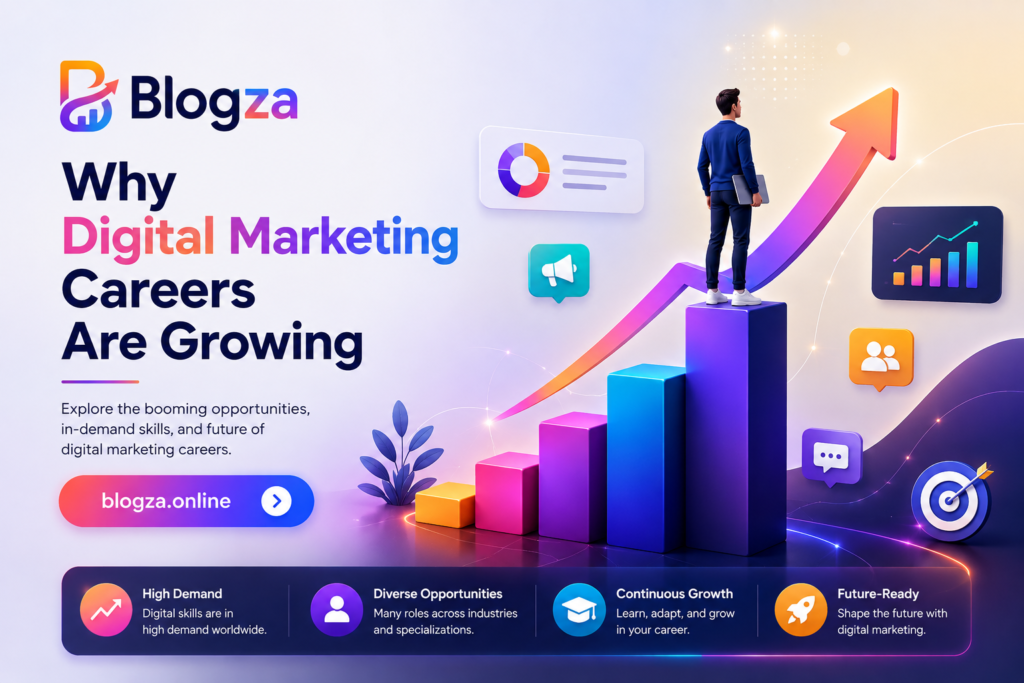
Businesses need online visibility because customers increasingly research products, services, companies, and solutions through digital channels before making decisions.
This creates opportunities for professionals who can help businesses:
- Increase organic search visibility
- Generate qualified website traffic
- Create useful content
- Improve conversions
- Manage social media communities
- Analyze marketing performance
- Build local search visibility
- Use AI responsibly
- Understand changing search behavior
- Connect marketing activity with business results
Another major change is the growth of AI-assisted search. Google has published guidance explaining that SEO fundamentals remain important for visibility in its generative AI search experiences. Its guidance also emphasizes valuable, unique, non-commodity content rather than trying to rely on special “AI ranking tricks.”
This means digital marketers need to understand both traditional search and newer AI-driven discovery.
Types of Digital Marketing Jobs
SEO Specialist
An SEO specialist works to improve a website’s visibility in organic search.
Typical responsibilities include keyword research, on-page SEO, technical SEO, internal linking, content optimization, competitor analysis, Search Console analysis, and SEO reporting.
A good SEO professional does more than insert keywords. They understand search intent, website architecture, crawling, indexing, content quality, user needs, and conversions.
Content Marketing Specialist
Content marketers create and manage valuable content designed to attract a specific audience.
Their work may include:
- Blog articles
- Guides
- Case studies
- Landing pages
- Social content
- Email content
- Video scripts
- Educational resources
Successful content marketing connects content with a real business objective instead of publishing articles simply to increase word count.
Social Media Specialist
Social media professionals create, publish, analyze, and optimize content across platforms.
The role can involve content calendars, community management, short-form video, campaign planning, social analytics, influencer collaboration, and brand communication.
Modern social media work is also becoming more connected with search. Google announced in July 2026 that Search Console platform properties became globally available for social and video platforms including Instagram, TikTok, X, and YouTube, allowing creators and marketers to analyze how this content performs in Google Search, Discover, and Google News.
Paid Media Specialist
Paid media specialists manage advertising campaigns through platforms such as Google Ads and social advertising networks.
They may work on:
- Campaign structure
- Audience targeting
- Ad copy
- Landing pages
- Conversion tracking
- Budget management
- A/B testing
- Cost and revenue analysis
This career path is particularly suitable for people who enjoy numbers, experimentation, and performance measurement.
Digital Marketing Strategist
A strategist looks at the bigger picture.
Instead of focusing on one channel, they may develop a complete plan involving SEO, content, email, social media, paid advertising, analytics, and conversion optimization.
This position usually requires broader experience because the marketer must understand how different channels support each other.
Technical SEO Specialist
Technical SEO focuses on the technical foundations that allow search engines to crawl, understand, and index websites effectively.
Relevant areas include:
- Crawling and indexing
- XML sitemaps
- Robots.txt
- Canonicalization
- Redirects
- Structured data
- Page experience
- Site architecture
- JavaScript SEO
- Mobile usability
Technical SEO can be especially valuable for marketers who enjoy websites, HTML, analytics, and problem-solving.
Local SEO Specialist
Local SEO helps businesses become more visible to customers searching within a geographic area.
Work can include Google Business Profile optimization, local landing pages, citations, reviews, local keyword research, and location-focused content.
Local SEO is particularly useful for businesses such as clinics, restaurants, agencies, service companies, and local retailers.
Skills You Need for Digital Marketing Jobs
You do not need to master every marketing discipline before applying for your first role. Instead, build a strong foundation and then develop specialization.
Core Digital Marketing Skills
Important foundational skills include:
- Search engine optimization
- Content marketing
- Keyword research
- Social media marketing
- Email marketing
- Analytics
- Conversion optimization
- Basic paid advertising
- Competitor research
- Marketing strategy
Understanding how these areas connect is more valuable than memorizing isolated definitions.
SEO Skills
SEO remains one of the most useful skill sets for digital marketers.
Learn:
- Search intent
- Keyword mapping
- On-page SEO
- Technical SEO
- Internal linking
- Content optimization
- Schema and structured data
- Search Console
- Analytics
- Local SEO
- Competitor analysis
Google’s current guidance for generative AI search also reinforces the importance of established SEO best practices.
AI and AI Search Skills
AI is changing how marketers research, create, analyze, and distribute content.
A digital marketer should learn how to use AI for tasks such as:
- Topic research
- Content briefs
- Keyword clustering
- Data analysis
- Content ideation
- Competitor research
- Workflow automation
- Draft assistance
- Content repurposing
However, AI output should be reviewed, fact-checked, edited, and improved by a human.
Google’s guidance specifically highlights the importance of providing original, valuable content and notes that its spam policies apply to generative AI responses in Search as well.
AEO and GEO Skills
AEO, or Answer Engine Optimization, generally focuses on structuring content so it can provide clear answers to questions.
GEO, commonly used for Generative Engine Optimization, focuses on improving the likelihood that useful information can be surfaced in AI-driven discovery experiences.
These terms are increasingly discussed in the marketing industry, but they should not be treated as replacements for SEO.
A practical approach is to:
- Answer important questions directly
- Use descriptive headings
- Provide concise definitions
- Support claims with trustworthy evidence
- Build topical depth
- Demonstrate first-hand expertise where possible
- Keep important information easy to understand
- Create original resources rather than generic summaries
Google’s May 2026 guidance specifically addressed common AEO/GEO misconceptions and emphasized that traditional SEO practices remain relevant for generative AI search features.
How to Start a Digital Marketing Career
Choose a Starting Specialization
Trying to learn everything simultaneously can slow your progress.
Choose one primary area such as SEO, content marketing, paid advertising, social media, or analytics.
You can then add supporting skills.
For example:
SEO + Content + AI can become a powerful combination for someone interested in organic growth.
Similarly:
Paid Ads + Analytics + CRO is a strong combination for performance marketing.
Build Practical Projects
Employers often want evidence that you can actually perform the work.
Instead of only collecting certificates, create practical projects.
You could:
- Build a small WordPress website
- Perform keyword research for a niche
- Create an SEO content plan
- Optimize several pages
- Configure Google Search Console
- Create a local SEO strategy
- Build a social media content calendar
- Analyze website traffic
- Create a sample Google Ads campaign
- Develop an AI-assisted content workflow
A project gives you something concrete to discuss during an interview.
Create a Portfolio
Your portfolio should show what you did, how you did it, and what you learned.
For an SEO project, for example, explain:
Problem: The website had weak organic visibility.
Research: You analyzed search intent, competitors, keywords, and existing pages.
Action: You improved content structure, internal links, metadata, and technical elements.
Measurement: You monitored impressions, clicks, rankings, and relevant conversions.
Even when you do not have client data, you can clearly label a project as a practice or personal project. Never invent results.
Tools That Help Digital Marketers
Digital marketing jobs often require familiarity with multiple tools.
SEO and Analytics Tools
Useful tools include:
- Google Search Console
- Google Analytics
- Google Trends
- Keyword research platforms
- Screaming Frog
- Semrush
- Ahrefs
- Rank Math
- Google Business Profile
You do not need to be an expert in every platform. Focus on understanding the marketing problem first and then learn the tool that helps solve it.
Content and Productivity Tools
Digital marketers can also benefit from:
- WordPress
- Canva
- Spreadsheet software
- AI assistants
- Project management platforms
- Email marketing platforms
- Social scheduling tools
The most valuable skill is not knowing where every button is. It is knowing how to use tools to produce measurable marketing outcomes.
How to Find Digital Marketing Jobs
Optimize Your Resume
Your resume should focus on skills and evidence rather than generic statements.
Instead of writing:
“Responsible for SEO.”
Use a clearer description such as:
“Performed keyword research, on-page optimization, internal linking, and Search Console analysis for WordPress websites.”
If you have measurable results, include them when they are genuine and verifiable.
Improve Your LinkedIn Profile
Your LinkedIn headline should clearly communicate your specialization.
For example:
Digital Marketing | SEO | WordPress | Content Marketing | AI Search
Your About section should explain what you can do, the tools you use, the type of problems you solve, and the kind of opportunity you want.
Search for Entry-Level Roles
Useful job titles include:
- Digital Marketing Intern
- Digital Marketing Executive
- SEO Intern
- SEO Executive
- SEO Specialist
- Content Marketing Executive
- Social Media Executive
- Digital Marketing Associate
- Marketing Coordinator
- Junior SEO Specialist
Do not automatically reject a role because the title is different from “Digital Marketer.” Read the responsibilities carefully.
Common Mistakes When Applying for Digital Marketing Jobs
Learning Without Practicing
Watching courses without creating projects can leave you unable to demonstrate your skills.
After learning a concept, apply it immediately.
Chasing Every New AI Tool
New AI tools appear constantly. Learning dozens of tools without understanding marketing fundamentals can create shallow knowledge.
Learn principles first and tools second.
Keyword Stuffing
Modern SEO is not about repeating a keyword as many times as possible.
Use the primary keyword naturally while covering related concepts, questions, entities, and user needs.
Publishing Generic AI Content
AI can accelerate content production, but automatically generated content can still be inaccurate, repetitive, or unhelpful.
Human review, original insights, trustworthy sourcing, editing, and useful examples remain important.
Ignoring Technical SEO
A beautiful article cannot compensate for serious crawling, indexing, architecture, or technical problems.
Basic technical knowledge makes a marketer more effective.
Focusing Only on Rankings
Rankings are useful, but they are not the final business goal.
A better digital marketer also considers:
- Qualified traffic
- Leads
- Conversions
- Revenue
- Engagement
- Customer acquisition cost
- Retention
Latest Google Search Developments
Digital marketers should monitor official Google Search documentation rather than relying exclusively on social media posts or SEO rumors.
As of August 2026, Google’s Search Status Dashboard lists an August 2026 spam update, which began on August 18 and affects ranking systems. The dashboard also records earlier 2026 core and spam updates.
Google’s Search documentation has also continued evolving around generative AI, AI Overviews, AI Mode, social content, and Search Console reporting. Its documentation states that AI Overviews are counted in Search Console’s Performance reporting.
For marketers, the practical lesson is simple: do not build a strategy around one algorithm rumor. Focus on useful content, strong technical foundations, clear information, genuine expertise, and continuous measurement.
Emerging Digital Marketing Trends
AI-Assisted Marketing
AI will continue to help marketers accelerate research, content workflows, analysis, personalization, and automation.
The competitive advantage will increasingly come from knowing when and how to use AI, rather than simply having access to it.
AI Search Optimization
Search is becoming more conversational and increasingly incorporates generative experiences.
Marketers should therefore create content that answers real questions clearly while maintaining strong SEO fundamentals.
First-Hand Expertise
Generic content is easy to produce. Original experience is harder to replicate.
Case studies, experiments, screenshots, original research, expert commentary, examples, and practical lessons can help differentiate content.
Search Beyond Traditional Web Pages
People discover information through search engines, social platforms, video platforms, communities, and AI tools.
Digital marketers therefore need a broader understanding of search visibility across multiple platforms, rather than treating Google rankings as the only source of discovery.
Data-Driven Decision Making
Marketing is becoming increasingly measurable.
Professionals who can interpret analytics, identify trends, test hypotheses, and explain business impact will have an advantage.
The Future of Digital Marketing Jobs
The future is unlikely to be about humans competing directly with AI on repetitive tasks.
Instead, marketers will increasingly combine human judgment with automation.
A professional who can research a market, understand customers, build a strategy, use AI to accelerate execution, verify information, analyze performance, and communicate results will be more valuable than someone who only knows how to produce content quickly.
The strongest career strategy is therefore to develop a T-shaped skill set: broad digital marketing knowledge combined with deeper expertise in one or two areas.
For example:
Broad knowledge: SEO, content, social media, analytics, AI, email, paid media
Deep expertise: Technical SEO + AI Search
That combination creates flexibility while maintaining a clear professional identity.
Frequently Asked Questions
What qualifications do I need for digital marketing jobs?
Many entry-level digital marketing roles do not require a specific university degree. Employers may prioritize practical skills, relevant experience, communication ability, analytical thinking, and evidence of completed projects.
Can I get a digital marketing job without experience?
Yes. A practical portfolio can help demonstrate your abilities when you have limited professional experience. Personal websites, volunteer projects, internships, freelance work, and clearly documented practice projects can all provide evidence of skills.
Which digital marketing skill should I learn first?
SEO, content marketing, analytics, and basic digital marketing fundamentals are strong starting points. Choose based on your interests and career goals, then develop supporting skills.
Are SEO jobs still relevant with AI search?
Yes. Google states that its generative AI search features are built on its existing Search quality and ranking systems, meaning established SEO best practices continue to matter.
Is AI replacing digital marketers?
AI is automating some repetitive tasks, but marketing still requires strategy, judgment, creativity, verification, customer understanding, and business decision-making. The better approach is to learn how AI can improve your workflow.
What is the difference between AEO and SEO?
SEO broadly focuses on improving visibility in search engines. AEO generally focuses on making information clear and useful for answer-oriented search experiences. In practice, strong content can support both.
What is GEO in digital marketing?
GEO is commonly used to describe optimization for generative AI or AI-driven discovery systems. Because terminology and practices are still evolving, marketers should focus on durable principles such as useful content, clear answers, expertise, originality, and strong SEO foundations.
How can I stand out when applying for digital marketing jobs?
Create a focused portfolio, demonstrate practical projects, explain your process, understand analytics, show familiarity with current search developments, and tailor your resume to the job description. Evidence of what you can actually do is more persuasive than a long list of tools.
Conclusion
Digital marketing jobs are expanding beyond traditional SEO, social media, and advertising. Today’s marketers need to understand how search, content, analytics, AI, websites, and customer behavior work together.
If you are starting your career, do not try to master everything at once. Choose a specialization, build practical projects, create a portfolio, learn industry-standard tools, and develop strong communication and analytical skills.
Most importantly, keep learning. Search engines, AI experiences, social platforms, and marketing technologies will continue to change. Google itself continues updating its documentation around AI search, Search Console, social content, and ranking systems.
The best digital marketer of the future will not simply know how to use the latest tool. They will know why to use it, how to evaluate its output, and how to turn digital activity into real business value
[…] example, a digital marketing agency serving Hyderabad could send […]
[…] Content is one of the most important areas where SEO and digital marketing overlap. […]
[…] has become a central part of modern digital marketing. A single campaign can require website images, social media graphics, email banners, videos, […]
[…] makes DAM part of the broader content operations and digital marketing workflow, rather than simply another storage […]
[…] technical issues are resolved, content, keyword targeting, internal linking, local SEO, and digital marketing campaigns can work from a stronger technical […]
[…] not mean businesses must choose only one. SEO and paid search can support different stages of a digital marketing strategy. For example, paid campaigns can provide immediate visibility for a new service while organic SEO […]