
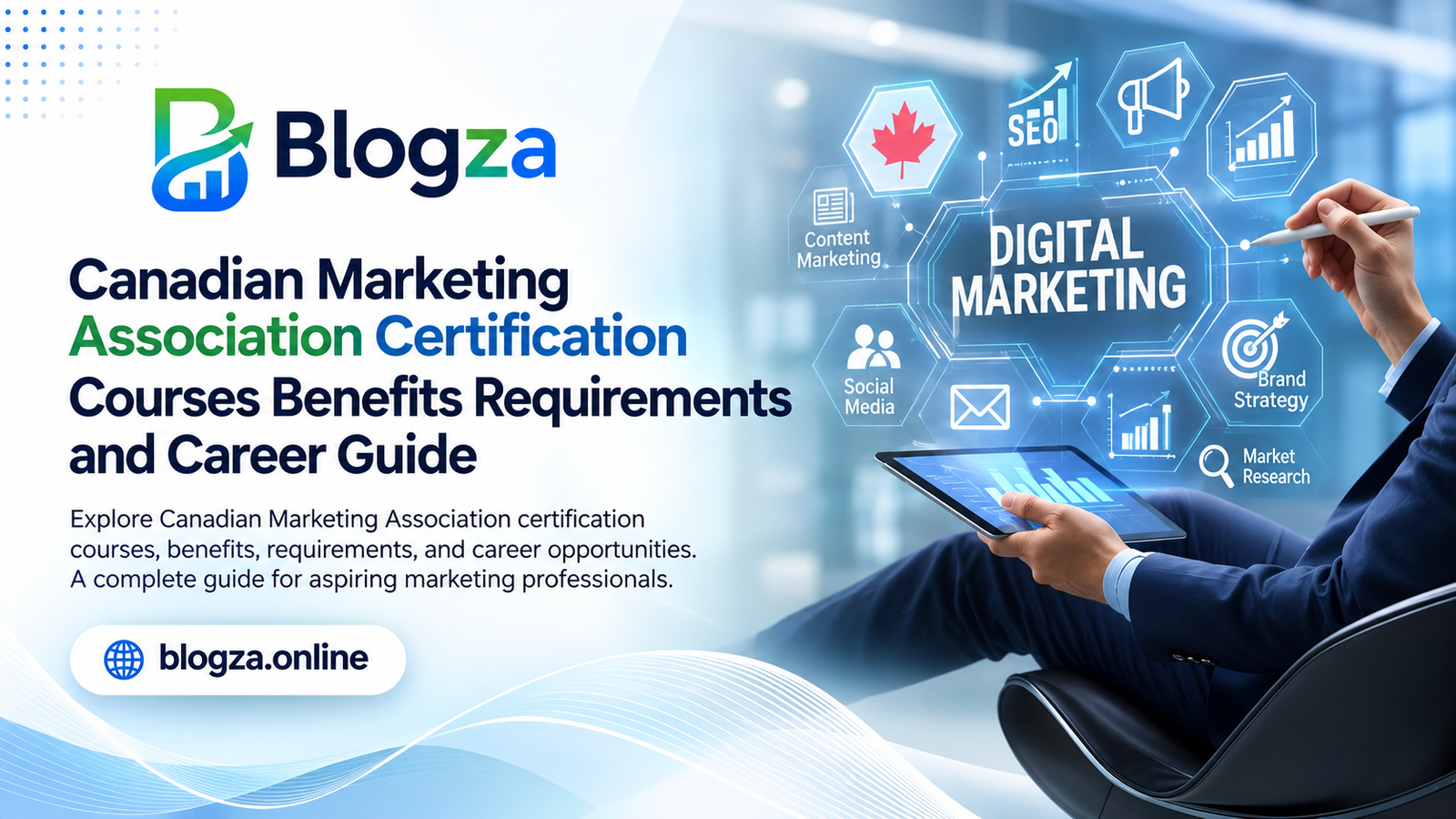
Learn about Canadian Marketing Association certification, CMA courses, Chartered Marketer, digital marketing credentials, benefits, and career.
Table of Contents
What Is Canadian Marketing Association Certification?
The Canadian Marketing Association (CMA) is a Canadian marketing industry association that provides professional development, education, training, networking, and other resources for marketers. Its learning portfolio includes online certificate courses, live training, specialized learning opportunities, and the Chartered Marketer designation.
When people search for Canadian Marketing Association certification, they may actually be referring to several different CMA learning options. CMA certificate courses focus on individual areas of marketing knowledge, while the Chartered Marketer (CM) is a broader professional designation established by the CMA.
CMA also offers a partnership with the Digital Marketing Institute (DMI), providing a dual certification option that combines CMA and DMI credentials. According to CMA, this dual certificate is recognized nationally and globally.
The distinction matters because a short certificate course and a professional designation serve different purposes. Someone who wants to learn digital analytics may benefit from a focused course, whereas an experienced marketing professional seeking a broader professional designation may consider the CM pathway.
What Does the CMA Offer?
The CMA Learning Hub is designed to support marketers at different stages of their careers, from aspiring professionals to experienced marketing leaders. Current CMA offerings include on-demand courses, instructor-led learning, live training, specialized programs, and pathways toward the Chartered Marketer designation.
CMA certificate courses are available online, with options that include self-paced and instructor-led formats. The organization says its certificate courses are developed by marketers and provide learners with CPD credits. After completing a certificate course, learners receive a digital CMA course certificate that can be shared with employers or professional networks.
This structure makes CMA learning relevant to different goals. A beginner might select a foundational digital marketing course, while an experienced marketer could pursue more advanced professional development or the Chartered Marketer pathway.
CMA Certificate Courses vs. Chartered Marketer
One of the most important questions surrounding Canadian Marketing Association certification is whether a CMA course certificate is the same as becoming a Chartered Marketer.
It is not.
A CMA certificate course demonstrates completion of a specific learning program. CMA currently lists courses such as Digital Marketing Strategy, Digital Analytics, Marketing Metrics, Generative AI for Marketers, Compliance for Marketers, Marketing in Canada, and Mastering Leadership Skills.
The Chartered Marketer (CM) is a professional designation. CMA describes it as the only marketing designation in Canada, with different pathways based on a person’s education and professional experience.
This means you should choose according to your objective:
| Goal | More suitable CMA option |
|---|---|
| Learn one specific marketing skill | CMA certificate course |
| Improve digital marketing knowledge | Digital Marketing Strategy or related course |
| Develop analytics skills | Digital Analytics or Marketing Metrics |
| Build AI marketing knowledge | Generative AI for Marketers |
| Pursue a professional marketing designation | Chartered Marketer |
| Combine Canadian and international digital marketing credentials | CMA x DMI dual certificate |
The credential that is most valuable depends on the role you want and the skills employers expect.
How CMA Certificate Courses Work
CMA’s certificate courses are designed to provide flexible professional learning. The current course portfolio includes both on-demand and instructor-led formats. On-demand courses allow learners to work independently, while instructor-led courses use a more structured approach with access to a live instructor. CMA states that both formats are delivered online.
For its on-demand certificate courses, CMA currently provides a four-month completion timeframe. This can be useful for working professionals who need to fit professional development around an existing job or other responsibilities.
Once the applicable course requirements have been completed, learners receive a digital CMA course certificate. The certificate can be presented to an employer, added to professional profiles, or used as evidence of continuing professional development.
Before registering, however, review the individual course page carefully. Course duration, delivery format, requirements, pricing, and assessment details can differ between programs.
Popular CMA Marketing Learning Areas
Digital Marketing Strategy
Digital marketing strategy is particularly relevant for professionals who need to connect marketing activities with broader business objectives. CMA’s Digital Marketing Strategy course covers essential elements of developing a digital strategy, including objectives, content, and modern management models.
A useful digital strategy should go beyond posting on social media or publishing blog articles. It should connect audience research, positioning, content, search visibility, conversion goals, measurement, and customer experience.
For example, a small business might combine SEO, content marketing, email, local search, and social media. The strategy should define which audience each channel serves and how success will be measured.
Digital Analytics
Marketing decisions increasingly depend on data. CMA’s Digital Analytics course focuses on fundamental concepts involving data and analytics, including tools, processes, metrics analysis, and evaluation of results.
Analytics skills are valuable because marketers need to understand what happened after a campaign launched. Instead of simply reporting traffic, a marketer should be able to investigate engagement, conversions, customer behavior, and the relationship between marketing activity and business outcomes.
These principles also complement SEO. Search performance, landing-page behavior, conversion data, and content engagement can help marketers decide where additional effort is justified.
Marketing Metrics
Marketing metrics help turn campaign activity into measurable business information. CMA currently offers Marketing Metrics as an on-demand certificate course focused on understanding and calculating key metrics to optimize spending and improve business results.
This is particularly useful for marketers who want stronger quantitative skills. Knowing definitions is not enough; the real value comes from interpreting metrics in context and using them to support decisions.
Generative AI for Marketers
AI has become an important part of modern marketing workflows. CMA currently offers Generative AI for Marketers, designed to help learners understand the changing technology landscape and use emerging technologies in marketing practice.
However, AI should complement marketing expertise rather than replace it. Effective marketers still need audience understanding, brand judgment, strategic thinking, data interpretation, creativity, editing skills, and ethical awareness.
AI can help with brainstorming, research organization, content ideation, analysis, personalization, and workflow automation, but human review remains important for accuracy, originality, brand consistency, and customer trust.
What Is the Chartered Marketer Designation?
The Chartered Marketer (CM) is the CMA’s professional marketing designation. CMA describes it as a professional pathway for marketers based on their education and experience.
Unlike a single short course, the CM designation represents a broader commitment to professional marketing development. CMA currently provides different routes depending on an individual’s background.
For example, the CMA Learning Hub describes an Education Path for people with a marketing diploma or degree and at least one year of marketing experience. It also describes an Experience Path for experienced marketers, including a pathway for people with eight years of diverse marketing experience.
There is also an Executive Advanced Standing route for eligible senior professionals. Because eligibility requirements can change, applicants should confirm the current criteria directly with CMA before making a decision.
Who Should Consider CMA Certification?
A CMA certificate can make sense for students, career changers, junior marketers, digital marketers, communications professionals, business owners, and experienced professionals who want structured learning.
For an early-career marketer, a focused certificate can demonstrate initiative and provide structured exposure to a particular area. For example, someone interested in SEO might benefit from broader digital strategy and analytics knowledge because modern search marketing involves content, technical website performance, data, user experience, and conversion measurement.
For an experienced marketer, a single certificate may be less significant than a broader professional development strategy. The Chartered Marketer designation may be more relevant if the individual meets the applicable requirements and wants a professional designation rather than simply completing an individual course.
Business owners can also use CMA learning to develop practical marketing knowledge without necessarily becoming full-time marketing specialists.
How CMA Certification Can Support a Digital Marketing Career
A certificate cannot guarantee employment, promotions, rankings, salary increases, or business growth. Its value depends on how it complements actual skills and experience.
For digital marketers, the strongest approach is to combine formal learning with practical projects. A portfolio might include an SEO audit, keyword research document, content strategy, local SEO project, analytics report, social media campaign, email campaign, or conversion-focused landing page.
This is particularly important because employers often evaluate what candidates can actually do. A certificate can demonstrate structured learning, while a portfolio can demonstrate application.
For example, a candidate who has completed a digital marketing certificate could create a project showing how they researched a target audience, selected keywords, built a content plan, optimized pages, measured organic traffic, and evaluated conversions. That combination provides much stronger evidence of practical ability than a credential alone.
CMA Certification and SEO Skills
CMA certification is not an SEO certification in the narrow sense, but several marketing skills taught through professional development can support effective SEO work.
Modern SEO involves much more than inserting keywords into an article. A capable SEO professional needs to understand search intent, content quality, information architecture, technical SEO, internal linking, analytics, conversion goals, and the needs of users.
Keyword research remains useful for discovering the language people use when searching. However, keyword selection should be connected to intent. A person searching “what is digital marketing” has a different need from someone searching “digital marketing agency for small business.”
Technical SEO is equally important. Website crawlability, indexing, site architecture, mobile usability, structured data where appropriate, page experience, and other technical factors can influence how effectively search engines understand and access a website.
CMA learning can therefore complement SEO by strengthening broader marketing strategy, analytics, content, and digital skills.
CMA Certification, AI Search, AEO and GEO
Search behavior is increasingly conversational, and marketers now need to think about how information can be understood and surfaced across traditional search and AI-powered experiences.
Answer Engine Optimization (AEO) focuses on creating clear, useful information that can satisfy direct questions. Generative Engine Optimization (GEO) is often used to describe efforts to make information more discoverable and useful in generative search experiences.
These concepts do not replace SEO fundamentals.
A strong foundation still includes accurate information, useful content, technically accessible websites, clear organization, relevant entities and concepts, and a good user experience. Content should answer real questions rather than being created solely to manipulate search features.
CMA’s current learning portfolio also reflects the importance of AI skills, with Generative AI for Marketers and current training focused on the relationship between AI and marketing.
For marketers, the practical lesson is simple: learn how AI can improve workflows while maintaining human oversight and sound marketing judgment.
Tools and Skills to Pair With CMA Learning
The best results usually come from combining certification with practical tools and complementary skills.
For SEO and digital marketing, useful areas include:
- Google Search Console for search performance analysis
- Google Analytics for website and user measurement
- Keyword research platforms for search-demand analysis
- Technical SEO crawlers for website auditing
- Content management systems such as WordPress
- Spreadsheet tools for campaign and keyword analysis
- Social media management platforms
- Email marketing platforms
- AI tools for research, ideation, analysis, and workflow support
The objective should not be to collect as many tools as possible. Instead, learn the tools that support the work you want to perform.
For example, an SEO specialist may need strong skills in technical auditing, keyword research, content optimization, analytics, and reporting. A social media specialist may place greater emphasis on content production, audience research, campaign management, creative testing, and social analytics.
How to Choose the Right CMA Program
Start with your career objective rather than the credential name.
If you are new to marketing, look for a course that develops fundamental knowledge. If you already understand marketing basics, select a specialization that addresses a clear skills gap.
Ask yourself:
- What marketing role am I targeting?
- What skills do current job descriptions require?
- Do I need a short certificate or a professional designation?
- Do I prefer self-paced or instructor-led learning?
- How much time can I realistically dedicate?
- Will I use the skills in a portfolio project?
- Does the credential fit my career location and target employers?
For someone targeting digital marketing, a combination of strategy, analytics, content, SEO, AI literacy, and practical experience can provide a stronger foundation than collecting unrelated certificates.
Common Mistakes When Pursuing Marketing Certification
Assuming Every Certificate Is a Professional Designation
A course completion certificate and a professional designation are not automatically equivalent. Always check what credential the program actually awards.
Choosing a Course Only Because of Its Name
A recognizable organization can add context to your professional profile, but the course still needs to match your career objective. Choose based on skills and outcomes, not just branding.
Ignoring Practical Experience
Certification is more useful when paired with practical work. Build projects that demonstrate what you learned.
Treating AI as a Replacement for Marketing Fundamentals
AI tools can accelerate workflows, but they do not remove the need for strategy, customer understanding, analytics, creativity, or critical thinking.
Failing to Check Current Requirements
Course offerings, fees, schedules, eligibility rules, and program structures can change. Always verify the latest information on the official CMA website before registering.
Latest Marketing Skills to Watch in 2026
The marketing profession continues to move toward a combination of strategic, analytical, digital, and AI-related capabilities.
CMA’s current training calendar reflects this shift, with programs covering areas such as AI and social media, strategic storytelling with AI, digital marketing strategy, B2B marketing, and marketing leadership.
For digital professionals, several areas deserve attention.
AI literacy is becoming increasingly useful because marketers need to understand how generative tools affect research, content, customer engagement, analytics, and productivity.
Data interpretation remains important because organizations need marketers who can connect campaigns with measurable business outcomes.
Strategic content also matters. Producing large quantities of AI-assisted content does not automatically create value. Marketers need to understand audience needs, search intent, brand positioning, differentiation, and customer journeys.
Search evolution is another important area. SEO professionals should understand traditional organic search alongside AI-assisted search experiences, conversational queries, local search, and answer-oriented content.
Is Canadian Marketing Association Certification Worth It?
For the right learner, it can be worthwhile.
The strongest reason to pursue a CMA certificate is not simply to add another line to a résumé. It is to gain structured knowledge from an established Canadian marketing organization and apply that knowledge to real marketing work.
CMA’s current certificate portfolio covers practical areas including digital strategy, analytics, metrics, AI, compliance, and marketing in Canada.
The Chartered Marketer designation can be a different proposition because it represents a broader professional pathway. CMA identifies it as its professional marketing designation and provides different routes based on education and experience.
Ultimately, the value depends on your circumstances. A certificate combined with practical skills, a portfolio, measurable results, and continuous learning can be much more useful than a credential collected without application.
Frequently Asked Questions
Is Canadian Marketing Association certification recognized?
CMA states that its certificate courses provide nationally recognized certificates, while its CMA x DMI programs provide a dual certification described as nationally and globally recognized. The Chartered Marketer is CMA’s professional marketing designation.
Recognition, however, should not be confused with guaranteed employment or a guaranteed salary increase. Employers can evaluate credentials differently depending on the position and organization.
Is the CMA certificate the same as the Chartered Marketer designation?
No. A CMA certificate generally represents completion of an individual certificate course. The Chartered Marketer is a broader professional designation with eligibility and pathway requirements.
Can beginners take CMA marketing courses?
Yes. CMA provides learning opportunities for different career stages, including aspiring marketers and early-career professionals. The appropriate course depends on your existing education, experience, and career objective.
Are CMA certificate courses online?
Yes. CMA currently offers online certificate courses in on-demand and instructor-led formats. Its on-demand courses provide flexible learning and a stated four-month timeframe for completion.
Does CMA offer digital marketing certification?
Yes. CMA currently offers digital marketing-related learning, including Digital Marketing Strategy and Digital Analytics, as well as a CMA x DMI dual certification pathway.
Does a CMA certificate help with an SEO career?
It can complement an SEO career by strengthening related skills such as digital strategy, analytics, content, and marketing measurement. However, an SEO candidate should also develop practical SEO skills such as keyword research, technical SEO, content optimization, internal linking, reporting, and website analysis.
Is the Chartered Marketer suitable for experienced marketers?
It can be. CMA provides pathways based on education and professional experience, including education and experience routes described on its Learning Hub. Experienced professionals should review the current eligibility requirements before applying.
How should I list a CMA credential on my résumé?
Use the exact credential name awarded by CMA. For an individual course, list the course title and CMA as the issuing organization. If you have earned the Chartered Marketer designation, use the official designation name and follow CMA’s current guidance for displaying the credential.

Conclusion
The phrase Canadian Marketing Association certification covers more than one learning option, so understanding the difference between CMA certificate courses and the Chartered Marketer designation is essential. CMA offers flexible professional development across areas such as digital marketing strategy, analytics, marketing metrics, generative AI, compliance, and other marketing disciplines.
For someone building a digital marketing career, the most effective approach is to connect certification with practical skills. Use structured learning to strengthen your knowledge, then apply it through SEO projects, content strategies, analytics reports, campaigns, websites, or other measurable marketing work.
If your objective is broader professional recognition and you meet the applicable requirements, investigate the Chartered Marketer pathway. If your immediate goal is to close a specific skill gap, a focused CMA certificate course may be the more practical choice.
The key is to choose the credential that matches your career stage and then turn what you learn into evidence of real-world capability.