
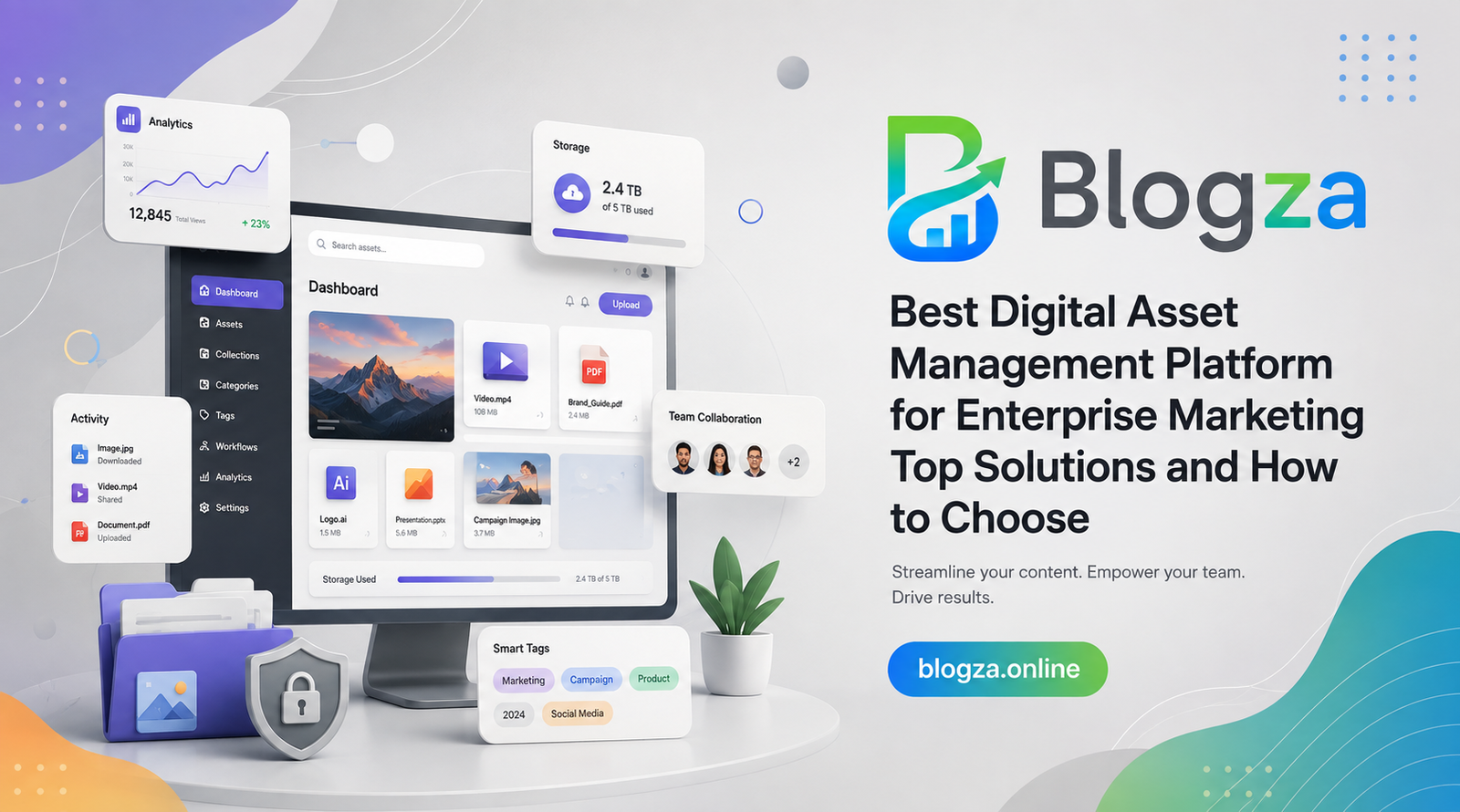
Best Digital
Discover the best digital asset management platform for enterprises to manage, approve, organize, and distribute content efficiently.
Table of Contents
What Is a Digital Asset Platform?
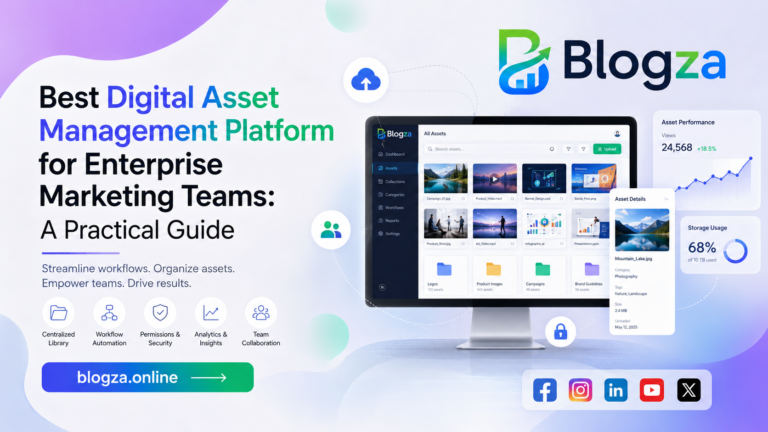
A digital asset management platform is a centralized system for storing, organizing, finding, managing, approving, and distributing digital content.
For an enterprise marketing team, digital assets can include:
- Product photography
- Brand logos
- Videos
- Social media graphics
- Advertisements
- Presentations
- PDFs
- Product documents
- Creative files
- Campaign materials
- Brand guidelines
- Templates
- AI-generated content
A DAM creates a controlled source of truth for these assets. Instead of marketing teams searching through email attachments, shared drives, cloud folders, or outdated file libraries, employees can use one structured system.
Modern enterprise DAM is increasingly more than a media library. It can connect with content management systems, creative applications, product information systems, ecommerce platforms, marketing automation tools, and other parts of the content supply chain. Recent enterprise DAM comparisons also emphasize AI-powered search, integrations, governance, scalability, and adoption as important selection criteria.
Why Enterprise Marketing Teams Need DAM
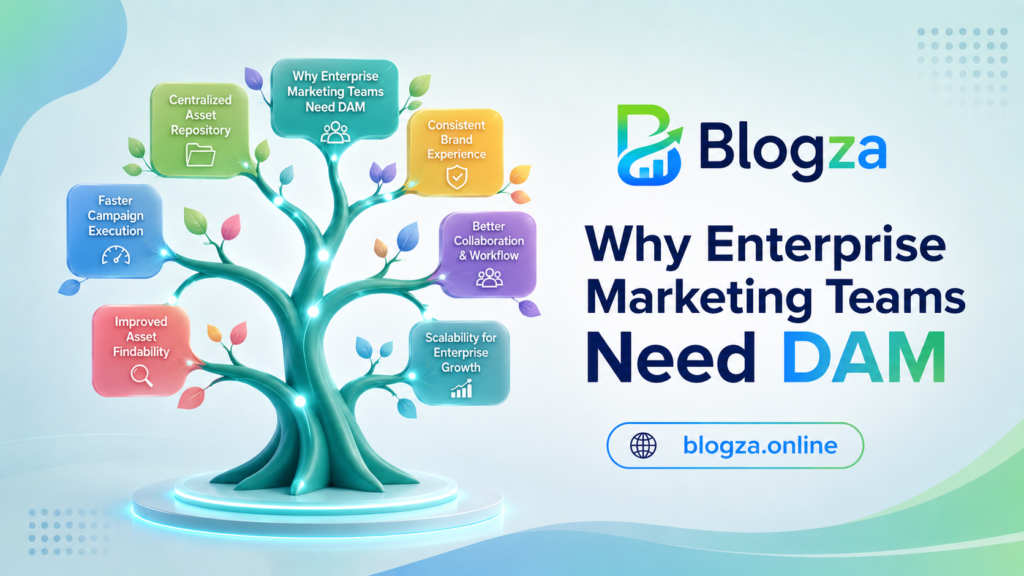
Large organizations create and distribute enormous amounts of content across websites, search engines, email, social media, paid advertising, ecommerce platforms, presentations, and regional campaigns.
Without centralized asset management, several problems can appear.
Scattered Marketing Assets
When assets are spread across multiple systems, employees may not know which file is current. A designer might create a new image even though an approved version already exists.
A DAM gives teams a central location for approved assets and makes them easier to locate.
Inconsistent Branding
Enterprise companies often operate across different countries, departments, agencies, and product lines.
Without proper governance, teams may use outdated logos, incorrect colors, old product images, or unapproved messaging.
DAM workflows can help organizations control versions, permissions, approvals, and brand standards.
Slow Content Production
Marketing teams need to move quickly. Finding the correct product image or campaign video should not take hours.
Metadata, AI-powered search, tagging, filters, and organized taxonomies can make asset discovery significantly easier.
Difficult Collaboration
Marketing rarely works as a single department. Designers, SEO specialists, content writers, social media managers, agencies, sales teams, and regional teams may all need access to the same content.
A DAM can provide controlled access while keeping teams aligned around approved materials.
How Enterprise DAM Works
A typical DAM workflow starts when an organization uploads an asset.
The platform then stores the file and associated information such as:
- File type
- Campaign
- Product
- Region
- Language
- Copyright status
- Usage rights
- Creation date
- Expiration date
- Brand category
- Keywords
- Department
Teams can then search and filter the library.
For example, a global ecommerce company could search for:
“summer campaign + women + UK + approved + 2026”
Instead of manually checking hundreds of folders, marketers can locate relevant assets using metadata and search functionality.
The workflow can continue through review, approval, distribution, and archiving.
This makes DAM part of the broader content operations and digital marketing workflow, rather than simply another storage solution.
Essential Features of the Best Enterprise DAM
The best digital asset management platform for enterprise marketing depends on organizational requirements, but several capabilities deserve close attention.
AI-Powered Search and Metadata
AI is becoming one of the most important DAM capabilities.
Modern platforms can use AI to assist with tagging, classification, visual search, metadata generation, and asset discovery. This is particularly valuable when organizations manage large image and video libraries.
However, AI should support a well-designed metadata structure rather than replace it completely.
Human review remains important for sensitive information, brand terminology, legal restrictions, and content accuracy.
Version Control
Enterprise teams need to know which asset is the latest approved version.
Version management helps prevent outdated content from being reused in campaigns.
This becomes especially important when multiple agencies or regional teams work on the same materials.
Permissions and Governance
A marketing asset may be approved for one country but not another. A product image may also have licensing restrictions.
A strong DAM should therefore provide appropriate controls for users, teams, assets, approvals, and distribution.
Integrations
Integrations can determine whether a DAM becomes an important part of the marketing workflow or simply another disconnected database.
Look for compatibility with:
- CMS platforms
- Creative software
- PIM systems
- Ecommerce platforms
- CRM systems
- Marketing automation
- Social media workflows
- Analytics platforms
- Content delivery systems
The goal is to reduce unnecessary downloading, uploading, and manual file transfers.
Scalability
An enterprise DAM should be able to support growing asset libraries, users, brands, markets, and campaigns.
Consider future requirements instead of evaluating only today’s content volume.
Analytics
Asset analytics can help marketers understand how content is being used.
Useful reporting may include asset downloads, usage, engagement, or distribution activity depending on the platform.
The most useful analytics are those connected to actual business and content workflows.
Best Digital Asset Management Platforms for Enterprise Marketing
There is no single DAM that is perfect for every enterprise. Current industry comparisons frequently evaluate platforms such as Bynder, Adobe Experience Manager Assets, Aprimo, Acquia DAM, MediaValet, Brandfolder, Canto, and Frontify, among others.
Bynder
Bynder is a strong option for enterprise marketing teams that prioritize brand management, asset discovery, collaboration, and marketing workflows.
Its marketing-focused approach can make it attractive to organizations that want teams to find and distribute approved content without depending heavily on technical staff.
Best for: Enterprise marketing and brand teams looking for a marketing-focused DAM.
Consider: Integration requirements, governance needs, implementation resources, and total cost.
Adobe Experience Manager Assets
Adobe Experience Manager Assets is particularly relevant to enterprises already using Adobe’s wider ecosystem.
Its connection with Adobe’s creative and experience technologies can be valuable for organizations that want their content lifecycle closely connected to their existing Adobe workflows.
Best for: Large organizations heavily invested in Adobe Creative Cloud and Experience Cloud.
Consider: Implementation complexity, technical requirements, licensing, and the overall Adobe ecosystem.
Aprimo
Aprimo combines digital asset management with broader marketing and content operations capabilities.
This makes it particularly interesting for organizations where DAM is only one component of a larger marketing operations strategy.
Best for: Large marketing organizations with complex workflows, governance, planning, and content operations.
Consider: Whether your organization actually needs its broader functionality.
Acquia DAM
Acquia DAM is designed for organizations that require structured asset management, metadata, integrations, and scalable content operations.
It can be particularly relevant to companies managing multiple brands, products, markets, or complex content structures.
Best for: Enterprises with structured content requirements and complex integrations.
MediaValet
MediaValet is a cloud-based DAM option that can appeal to organizations managing substantial image and video libraries.
Its AI-supported search and asset discovery capabilities are relevant to marketing teams that need to find visual content quickly.
Best for: Large teams with significant visual content requirements.
Brandfolder
Brandfolder focuses strongly on brand asset organization, distribution, and collaboration.
It can be useful for companies that frequently share approved assets with agencies, partners, distributors, or other external stakeholders.
Best for: Brand-focused marketing teams that need controlled asset sharing and distribution.
Canto
Canto provides DAM capabilities with an emphasis on usability and straightforward asset organization.
It can be worth considering for organizations that want a balance between functionality and ease of adoption.
Best for: Marketing teams that prioritize usability and practical asset management.
Frontify
Frontify combines digital asset management with brand management and brand guidelines.
That makes it useful for organizations where maintaining consistent brand execution across teams is a major priority.
Best for: Distributed enterprise teams focused heavily on brand consistency and guidelines.
How AI Is Changing Enterprise DAM
AI is changing how marketing teams create, organize, discover, and distribute content.
In DAM, AI can support:
- Automatic metadata suggestions
- Image recognition
- Visual search
- Content classification
- Asset recommendations
- Duplicate detection
- Search assistance
- Workflow automation
- Content personalization
The important point is that AI should solve real workflow problems.
For example, imagine a company with 500,000 product images. A traditional folder structure may make discovery difficult. AI-assisted visual search could help marketers find visually similar assets or identify content based on descriptive attributes.
However, organizations should establish governance around AI-generated metadata and content.
AI output should be reviewed where inaccurate information could create legal, brand, accessibility, or customer-experience problems.
DAM, SEO, AEO, and GEO
DAM also has an indirect relationship with modern search optimization.
DAM and SEO
A DAM can help SEO teams maintain consistent images and supporting content across websites.
Important image SEO practices still include:
- Descriptive filenames
- Accurate alternative text
- Appropriate image formats
- Relevant surrounding content
- Efficient image delivery
- Proper image dimensions
- Clear ownership and licensing
A DAM alone does not guarantee better rankings. SEO results depend on the complete website, content quality, technical implementation, relevance, authority, and user experience.
DAM and AEO
Answer Engine Optimization focuses on making information easier for answer systems to understand and use.
DAM can support this indirectly by helping organizations maintain accurate product information, approved visuals, brand documentation, and structured content.
For example, a product marketing team can connect approved product assets with accurate descriptions and supporting documentation, reducing inconsistencies across channels.
DAM and GEO
Generative Engine Optimization is concerned with visibility in AI-powered search and answer experiences.
Google has emphasized that the fundamentals for succeeding in AI search experiences remain focused on creating unique, useful content for people rather than producing content specifically for a search feature.
This means DAM should be treated as infrastructure supporting high-quality content operations—not as an artificial shortcut to AI visibility.
How to Choose the Right DAM Platform
Choosing the best digital asset management platform for enterprise marketing should begin with business requirements rather than vendor features.
Audit Your Existing Content Workflow
Document how assets currently move from creation to publication.
Ask:
- Where are assets stored?
- Who approves them?
- How are versions managed?
- How do regional teams access files?
- How are expired assets removed?
- Which systems need integrations?
- How much time is spent searching for files?
This identifies the actual problems the DAM needs to solve.
Define Your Metadata Structure
Metadata is critical to discoverability.
Create a practical taxonomy around categories such as:
- Product
- Campaign
- Market
- Region
- Content type
- Language
- Usage rights
- Brand
- Audience
- Date
- Approval status
Avoid creating hundreds of fields that employees will not maintain.
Evaluate Integrations
Make a list of the systems your marketing team already uses.
Then determine whether each DAM integrates directly, through APIs, connectors, or other supported methods.
A DAM that fits your existing marketing technology stack will generally be easier to adopt than one that requires teams to constantly move files manually.
Test Search With Real Assets
Do not evaluate search only with vendor demonstrations.
Take a sample of your organization’s real assets and ask users to find specific files.
Measure:
- Search accuracy
- Time to find an asset
- Filtering quality
- Metadata usefulness
- Duplicate detection
- User experience
This gives you practical evidence for comparing platforms.
Calculate Total Cost of Ownership
Do not look only at the subscription price.
Consider:
- Licensing
- Storage
- Implementation
- Migration
- Integrations
- Metadata development
- Training
- Administration
- Customization
- Support
- Change management
Enterprise DAM costs vary significantly by users, storage, modules, integrations, and implementation requirements, and vendors commonly use custom pricing.
Common Enterprise DAM Mistakes
Buying Too Many Features
A platform can have hundreds of features and still fail if employees do not use it.
Prioritize the workflows that matter most.
Ignoring Metadata
Poor metadata makes a sophisticated DAM difficult to search.
Build a clear taxonomy before migrating thousands of assets.
Migrating Everything Without Cleanup
Moving an old chaotic file structure into a new system does not solve the underlying problem.
Remove duplicates, outdated content, irrelevant files, and assets with unclear ownership before migration where practical.
Forgetting User Adoption
Employees need training and clear processes.
Explain why the DAM exists, how assets should be uploaded, how metadata should be applied, and which files are considered approved.
Treating AI as a Replacement for Governance
AI can accelerate content operations, but it does not remove the need for human oversight.
Organizations should establish clear policies for AI-generated metadata, images, copy, rights, and approvals.
Latest Enterprise DAM Trends
AI-Native Content Operations
AI is moving DAM beyond simple search and tagging toward automated content workflows.
The broader enterprise market is increasingly considering how DAM fits into an organization’s AI strategy, not just its storage requirements.
Content Supply Chain Integration
DAM is increasingly connected with CMS, PIM, creative tools, ecommerce, marketing automation, and distribution systems.
This creates a more connected content supply chain where approved assets can move efficiently from creation to publication.
Search Across More Content Types
As companies produce more video, audio, presentations, 3D content, and AI-generated assets, DAM search needs to work across more than traditional image files.
Stronger Governance
As content volumes increase, organizations need stronger controls around rights, approvals, versions, brand consistency, and access.
Human-AI Collaboration
The future of enterprise marketing is unlikely to be purely automated.
AI can accelerate repetitive work while people continue to provide strategy, creativity, judgment, brand direction, and quality control. Recent marketing research and industry commentary similarly emphasize combining AI efficiency with human creativity and governance.
Frequently Asked Questions
What is the best digital asset management platform for enterprise marketing?
There is no universal winner. Bynder can be a strong marketing-focused option, Adobe Experience Manager Assets is particularly suitable for Adobe-centric enterprises, Aprimo fits complex content operations, while other platforms such as Acquia DAM, MediaValet, Brandfolder, Canto, and Frontify may fit different organizational requirements.
What does enterprise DAM software do?
Enterprise DAM software centralizes digital assets and helps organizations organize, search, approve, manage, govern, and distribute content across teams and channels.
Why do marketing teams need digital asset management?
Marketing teams use DAM to improve asset discoverability, brand consistency, collaboration, version control, governance, and content distribution.
Does DAM improve SEO?
DAM does not directly guarantee higher search rankings. However, it can support SEO workflows by helping teams organize approved images, metadata, brand assets, and content used across websites and campaigns.
How does AI help digital asset management?
AI can assist with search, tagging, classification, visual recognition, metadata generation, recommendations, and workflow automation. Human review remains important for accuracy and governance.
Is enterprise DAM expensive?
Enterprise DAM pricing varies significantly. Many platforms use custom pricing based on factors such as users, storage, features, integrations, and implementation requirements. Organizations should evaluate total cost of ownership rather than subscription price alone.
What should I check before buying a DAM?
Evaluate search, metadata, permissions, version control, integrations, scalability, security, workflows, analytics, user experience, AI capabilities, implementation requirements, and total cost.
Can a DAM replace a CMS?
Usually, no. A DAM manages digital assets, while a CMS primarily manages website content and publishing. The two systems often work together.
Conclusion
The best digital asset management platform for enterprise marketing is not necessarily the platform with the longest feature list. It is the platform that fits your organization’s content workflows, technology stack, governance requirements, users, and long-term marketing strategy.
Start by identifying your biggest content problems. Then evaluate search, metadata, AI capabilities, integrations, permissions, version control, scalability, analytics, and adoption.
For Adobe-heavy organizations, Adobe Experience Manager Assets may be a natural candidate. Marketing-first teams may consider Bynder, while organizations focused on broader content operations can evaluate Aprimo. Acquia DAM, MediaValet, Brandfolder, Canto, and Frontify can also make sense depending on specific requirements.
Most importantly, test shortlisted platforms using your real marketing assets and real workflows.
A successful DAM implementation is ultimately not about buying another software platform. It is about creating a reliable content system that helps people find the right asset, use the right version, follow brand and legal requirements, and move high-quality content to the right channel faster.
As AI search, AEO, GEO, content marketing, and omnichannel experiences continue evolving, strong content organization and governance will become increasingly valuable. The organizations that combine good technology with clear processes, useful content, human expertise, and responsible AI adoption will be better positioned for the future of digital marketing.
[…] Marketing asset management is closely related to digital asset management (DAM). The distinction is often about perspective and workflow rather than a completely separate technology category. A DAM platform may serve an entire organization, while marketing asset management focuses specifically on the needs of marketing teams and their campaigns. […]
[…] course demonstrates completion of a specific learning program. CMA currently lists courses such as Digital Marketing Strategy, Digital Analytics, Marketing Metrics, Generative AI for Marketers, Compliance for Marketers, […]