
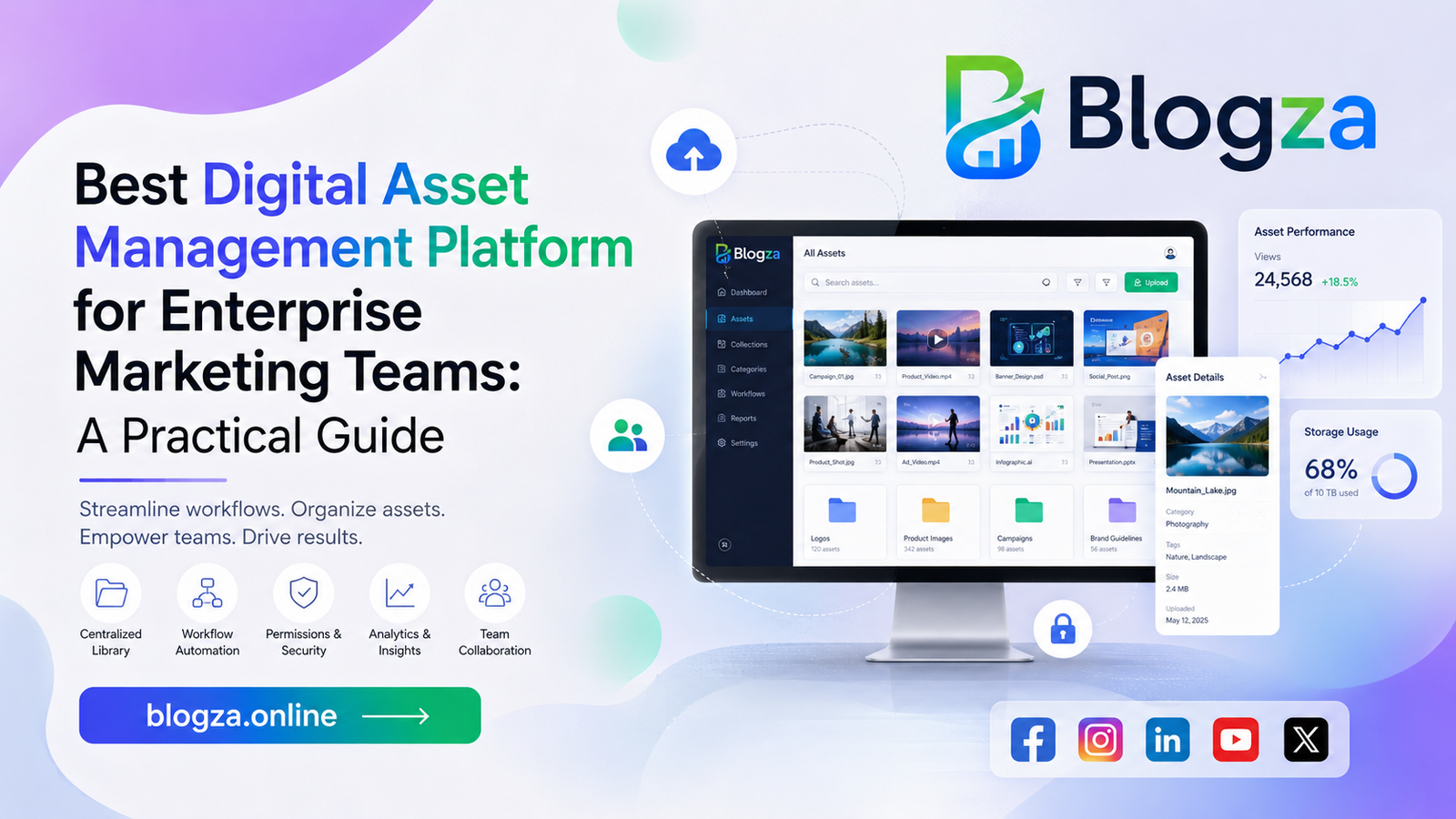
Compare the best digital asset management platforms for enterprise marketing teams, including features, workflows, AI, governance, and SEO considerations.
Table of Contents
What Is Digital Asset Management?
Digital asset management is the organized process of storing, categorizing, managing, searching, approving, and distributing digital files from a centralized system.
Typical assets include:
- Brand logos
- Product photography
- Social media graphics
- Videos
- Presentations
- PDFs
- Advertisements
- Campaign creative
- Audio files
- Product documentation
- Design files
- Brand guidelines
A DAM is more than cloud storage. The difference is the management layer around the files.
For example, an enterprise marketing team may need to know:
- Who owns an asset?
- Which version is approved?
- Where can it be used?
- When does its license expire?
- Which campaign does it belong to?
- Which region is allowed to use it?
- What other assets are related to it?
- Can an employee download or modify it?
Modern DAM systems address these questions through metadata, permissions, workflows, versioning, search, governance, and distribution capabilities.
Adobe’s current documentation, for example, describes search as central to DAM usage and supports asset metadata, tags, versions, workflows, collections, and permissions.
Why Enterprise Marketing Teams Need a DAM
A small marketing team may be able to manage assets using a shared drive. At enterprise scale, that approach becomes difficult to maintain.
Marketing teams often work across departments, agencies, countries, product lines, and channels. The same campaign may require dozens of image variations, videos, banners, documents, and localized creative files.
A DAM creates a central source of truth for those materials.
Faster asset discovery
One of the biggest operational problems in marketing is finding an existing asset.
A designer might have created the correct product image six months earlier, but another marketer may not know where it is stored. Instead of recreating the asset, a searchable DAM can help users locate the existing version through metadata, tags, filenames, filters, or other discovery mechanisms.
This matters because better discoverability can reduce duplicated work and make existing content easier to reuse.
Better brand consistency
Enterprise organizations often have multiple marketing teams producing content simultaneously.
Without governance, outdated logos, incorrect colors, old campaign messaging, or unapproved photography can easily appear in public-facing materials.
A DAM can establish approved assets and permissions so teams have a clearer path to the latest brand materials.
Stronger content governance
Enterprise marketing involves legal, licensing, and brand considerations.
An asset might have an expiration date or geographic usage restriction. A DAM can help organizations manage asset status, permissions, expiration, approvals, and other governance requirements.
Adobe’s current AEM Assets documentation describes capabilities such as role-based permissions, asset expiration, approval workflows, version control, and governance features.
How a DAM Works for Enterprise Marketing
A typical enterprise DAM workflow looks like this:
Create → Upload → Enrich → Review → Approve → Organize → Distribute → Monitor → Archive
The process starts when creative assets are produced. Those assets are uploaded into the DAM and enriched with information such as campaign name, product, market, asset type, usage rights, and other metadata.
Marketing or legal teams can then review and approve the assets. Once approved, marketers can search for and use them across relevant channels.
Some enterprise DAM platforms can also connect asset delivery with websites, commerce platforms, creative applications, content systems, and other marketing technologies.
Adobe describes AEM Assets as a centralized repository that can support asset management, metadata, workflows, distribution, and integrations.
Key Features to Look for in an Enterprise DAM
The best DAM for your organization should be evaluated against business requirements rather than a generic feature checklist.
Advanced Search and Metadata
Search is one of the most important DAM capabilities.
Enterprise teams should be able to find assets using structured metadata, tags, filters, asset type, campaign, product, market, creator, or other relevant attributes.
A well-designed metadata structure is especially important as the asset library grows. Adobe notes that relying on filenames alone does not scale effectively as the number of assets and users increases.
When evaluating a platform, ask:
- Can administrators create custom metadata fields?
- Can users filter by multiple attributes?
- Does the platform support taxonomy management?
- Can AI-assisted search improve discovery?
- Can users find visually similar assets?
- Can metadata be imported or updated in bulk?
Version Control
Marketing assets frequently change.
A product image may be updated, a campaign banner may receive a new headline, or a legal team may require changes to a document.
Version control helps teams understand which file is current and preserves previous versions when needed.
This is particularly valuable when multiple departments or external agencies collaborate on the same campaigns.
Workflow and Approval Management
Enterprise marketing rarely operates through simple upload-and-download processes.
Assets may require:
Creative review → Marketing approval → Legal approval → Brand approval → Publication
A DAM should support configurable workflows where appropriate.
The goal is to make approval processes visible and repeatable instead of depending entirely on email conversations and spreadsheets.
Permissions and Governance
Not every employee should necessarily have unrestricted access to every asset.
An enterprise DAM should provide appropriate controls for:
- User permissions
- Team permissions
- Download rights
- Editing rights
- Approval responsibilities
- Asset visibility
- Usage restrictions
Governance becomes particularly important when organizations work with licensed photography, regulated products, external agencies, or region-specific content.
Integrations
DAM software becomes significantly more valuable when it fits into the existing marketing ecosystem.
Consider integrations with:
- CMS platforms
- E-commerce platforms
- Creative software
- Marketing automation
- Product information management
- Project management
- Social media workflows
- Analytics platforms
- Cloud storage
- Content delivery systems
Adobe, for example, documents integrations between AEM Assets and Creative Cloud, Workfront, Commerce, Adobe Express, and other Adobe technologies.
Best Digital Asset Management Platforms for Enterprise Marketing Teams
There is no single DAM that is objectively best for every enterprise. However, several platforms are worth evaluating when building an enterprise DAM shortlist.
Adobe Experience Manager Assets
Adobe Experience Manager Assets is a strong option for organizations already invested in the Adobe ecosystem or requiring sophisticated enterprise content management and asset workflows.
AEM Assets provides centralized asset management alongside capabilities for metadata, search, workflows, governance, delivery, and integrations. Adobe describes its current cloud offering as a cloud-native DAM with AI/ML capabilities and multiple user experiences for different DAM personas.
Its ecosystem can be particularly attractive to organizations using tools such as Adobe Creative Cloud, Adobe Workfront, Adobe Commerce, or other Adobe marketing technologies.
AEM Assets can also support content delivery through Dynamic Media and Content Hub, while APIs can help developers connect asset delivery to applications and websites.
Best suited for: large enterprises with complex content operations, substantial Adobe investment, sophisticated governance needs, and technical resources.
Bynder
Bynder is another prominent enterprise DAM platform focused on centralized asset management, brand governance, content discovery, and activation.
Its current product materials emphasize AI-powered search, centralized content management, brand governance, and scalability. Bynder also describes its DAM as a system of record for brand content and provides tools for discovering assets through natural-language and image-based search.
Bynder may be attractive to marketing organizations that want a dedicated DAM environment centered heavily on brand and content operations.
Best suited for: enterprise marketing and brand teams looking for centralized asset management, discovery, governance, and content activation.
Cloudinary
Cloudinary is worth considering when an organization has particularly strong requirements around media management, transformation, optimization, and delivery.
Its positioning is especially relevant for organizations handling large volumes of images and video across websites, applications, e-commerce, and digital experiences.
For a business where media delivery and technical image/video workflows are central to the marketing stack, it can be useful to evaluate Cloudinary alongside traditional enterprise DAM platforms.
Best suited for: digital-first businesses with substantial image/video delivery and technical media-management requirements.
Other DAM Platforms
The enterprise DAM market also includes platforms with different strengths and approaches. Depending on the organization’s size and workflow, buyers may evaluate solutions such as Canto and other specialized or mid-market DAM products.
The important point is to avoid choosing a DAM solely because it appears frequently in comparison articles. The platform should be tested against actual workflows, users, integrations, governance requirements, and asset volumes.
DAM Comparison: What Should Enterprise Buyers Evaluate?
| Requirement | What to Look For |
|---|---|
| Asset organization | Folders, collections, taxonomy, metadata |
| Search | Filters, tags, AI-assisted discovery, visual search |
| Governance | Permissions, approvals, expiration, rights |
| Collaboration | Reviews, comments, workflows |
| Versioning | Version history and controlled updates |
| Integrations | CMS, creative, commerce, marketing tools |
| Distribution | Portals, APIs, delivery tools, sharing |
| Scalability | Large asset libraries and many users |
| AI capabilities | Tagging, discovery, classification, automation |
| Analytics | Asset usage and operational insights |
| Security | Access controls and enterprise security |
| Administration | Roles, governance, reporting, configuration |
How to Choose the Right DAM for Your Marketing Team
Start with your content lifecycle, not the vendor.
Document how an asset currently moves through your organization.
For example:
Brief → Design → Review → Legal → Approval → Campaign → Distribution → Archive
Then identify where problems occur.
Are people unable to find assets? Are outdated files being published? Do agencies lack access? Are marketers recreating existing creative? Are approvals handled manually?
Once these problems are documented, create a requirements matrix.
Prioritize requirements
Separate requirements into three categories:
Must-have: capabilities the organization cannot operate without.
Important: features that provide meaningful efficiency or governance benefits.
Nice-to-have: capabilities that could improve the experience but are not essential.
This prevents vendor demos from becoming feature competitions.
Test real workflows
During a DAM evaluation, do not only watch a sales presentation.
Ask vendors to demonstrate real scenarios:
- Uploading a campaign
- Adding metadata
- Searching for an old asset
- Creating a new version
- Approving an asset
- Restricting access
- Sharing assets with an agency
- Removing an expired asset
- Delivering assets to another system
This gives stakeholders a much better understanding of whether the platform works in practice.
DAM, SEO and Digital Marketing
DAM software is not an SEO tool, but it can support a broader digital marketing workflow.
For example, organized media libraries can help content teams locate appropriate images, videos, documents, and brand assets more efficiently.
However, a DAM does not automatically make a website rank better.
SEO still depends on fundamentals such as:
- Search intent
- Helpful content
- Technical SEO
- Internal linking
- Crawlability
- Structured data where appropriate
- Page experience
- Relevant titles and descriptions
- Quality external references
- Strong information architecture
Google’s current guidance emphasizes helpful, reliable, people-first content and warns against creating content primarily to manipulate search rankings.
Therefore, the right approach is to treat DAM as content infrastructure that supports marketing, rather than as an SEO shortcut.
DAM and AI Search, AEO and GEO
AI is becoming increasingly relevant to enterprise content operations.
Modern DAM platforms can use AI for areas such as asset classification, tagging, search, discovery, workflow assistance, and content operations. Adobe currently describes AI/ML capabilities within AEM Assets, while Bynder highlights AI-powered asset discovery.
For marketers, however, AI should solve real operational problems rather than be adopted simply because it is a trend.
A useful AI-enabled DAM workflow could help a marketer search for:
“Approved product images for the summer campaign in the UK.”
Instead of manually browsing hundreds of folders, the system may use metadata, natural-language search, tags, permissions, and other signals to surface relevant assets.
This can support faster content production.
What about Google AI Overviews and AI Mode?
DAM software does not have a special setting that guarantees visibility in Google’s AI features.
Google states that the same foundational SEO principles remain relevant for AI Overviews and AI Mode. Pages need to meet normal technical requirements and be eligible for Google Search; Google does not specify additional technical requirements for appearing as supporting links in these AI experiences.
That means AEO and GEO should focus on fundamentals such as clear answers, useful structure, trustworthy information, strong topical coverage, and technically accessible content—not supposed “AI ranking hacks.”
Common Enterprise DAM Mistakes
Choosing features instead of workflows
A platform can have an impressive feature list and still be a poor fit.
Always connect features to actual business requirements.
Ignoring metadata strategy
A DAM filled with poorly labeled assets becomes difficult to use.
Define taxonomy, naming conventions, required metadata, ownership, and governance before migrating thousands of files.
Treating migration as a simple upload
DAM migration can involve duplicates, outdated files, inconsistent naming, missing rights information, and incompatible formats.
Clean the existing library before importing everything.
Forgetting external users
Agencies, freelancers, distributors, partners, and regional teams may need controlled access.
Include these users when designing permissions and workflows.
Buying without testing integrations
A DAM should fit the wider technology ecosystem.
Test the systems that marketing actually uses rather than assuming integration will be easy because an API exists.
Measuring success only by adoption
User adoption matters, but enterprise DAM performance should also be connected to operational outcomes.
Useful measures may include:
- Asset search efficiency
- Asset reuse
- Duplicate reduction
- Approval turnaround
- Content production time
- Governance compliance
- External sharing efficiency
Latest Enterprise DAM Trends
Several developments are shaping DAM strategy in 2026.
AI-assisted discovery
AI-powered search is becoming increasingly important as organizations manage larger and more complex asset libraries.
Governance for AI-generated content
As organizations use generative AI to create images, text, and other media, provenance, approval, rights, and brand governance become increasingly important.
Adobe’s current AEM Assets documentation includes Content Credentials and describes provenance-related capabilities based around the C2PA standard.
API-first content delivery
Enterprise organizations increasingly need assets to move between DAMs, websites, applications, commerce systems, and other platforms.
APIs and structured delivery capabilities therefore matter more than simply having a good web-based asset library.
Brand governance at scale
As companies produce more localized and personalized marketing content, maintaining consistent brand standards becomes harder.
DAM platforms are increasingly being positioned as infrastructure for controlled content reuse and activation.
Frequently Asked Questions
What is the best digital asset management platform for enterprise marketing teams?
There is no universally best platform. Adobe Experience Manager Assets and Bynder are strong options for enterprise organizations, while other platforms may be better depending on media delivery, integrations, workflow complexity, and budget.
Is Adobe Experience Manager Assets good for enterprise marketing?
Yes. AEM Assets is designed for enterprise digital asset management and provides capabilities including asset organization, metadata, search, governance, workflows, integrations, and content delivery.
What should I look for in an enterprise DAM?
Prioritize search, metadata, governance, permissions, version control, workflows, integrations, scalability, security, distribution, and usability. The exact priorities should come from your organization’s content lifecycle.
Is DAM the same as cloud storage?
No. Cloud storage primarily provides file storage and access. DAM adds specialized capabilities for metadata, search, asset governance, versioning, workflows, permissions, approvals, and content distribution.
Can a DAM improve SEO?
Indirectly, yes. A DAM can make it easier for marketing and content teams to organize and reuse digital assets. However, DAM software itself does not guarantee better rankings. SEO still requires strong technical and content fundamentals.
Does AI make traditional DAM obsolete?
No. AI can improve search, classification, automation, and discovery, but organizations still need structured metadata, permissions, governance, workflows, and reliable asset management.
Is DAM useful for small marketing teams?
It can be, particularly when teams manage many assets or collaborate with external partners. However, smaller organizations should evaluate whether the complexity and cost of an enterprise DAM are justified by their actual needs.
How should an enterprise measure DAM success?
Measure outcomes such as asset discoverability, reuse, approval efficiency, duplicate reduction, content production time, governance compliance, and user adoption. The metrics should connect the DAM to actual marketing operations.

Conclusion
Choosing the best digital asset management platform for enterprise marketing teams is ultimately a business and workflow decision, not simply a software comparison.
The right platform should give marketing teams a reliable source of truth for their digital content while making assets easier to find, approve, govern, reuse, and distribute. Enterprise buyers should pay particular attention to metadata, search, permissions, workflows, integrations, scalability, security, and AI-assisted capabilities.
Adobe Experience Manager Assets can be particularly compelling for organizations with sophisticated enterprise content requirements and a strong Adobe ecosystem. Bynder is another important option for organizations prioritizing centralized DAM, brand governance, and AI-assisted discovery. Other platforms may be better for organizations with specialized media-delivery or simpler asset-management requirements.
Most importantly, choose the DAM based on real workflows rather than marketing claims. Document your current asset lifecycle, define must-have requirements, test real scenarios, involve marketing and technical stakeholders, and evaluate how the platform will support your content operations over the next several years.
For digital marketers, the broader lesson is equally important: strong content operations are becoming part of modern digital marketing infrastructure. As organizations produce more content across websites, search, social media, advertising, commerce, and AI-driven experiences, organized and governed digital assets become increasingly valuable.


[…] best digital asset management platform for enterprise marketing depends on organizational requirements, but several capabilities deserve […]