
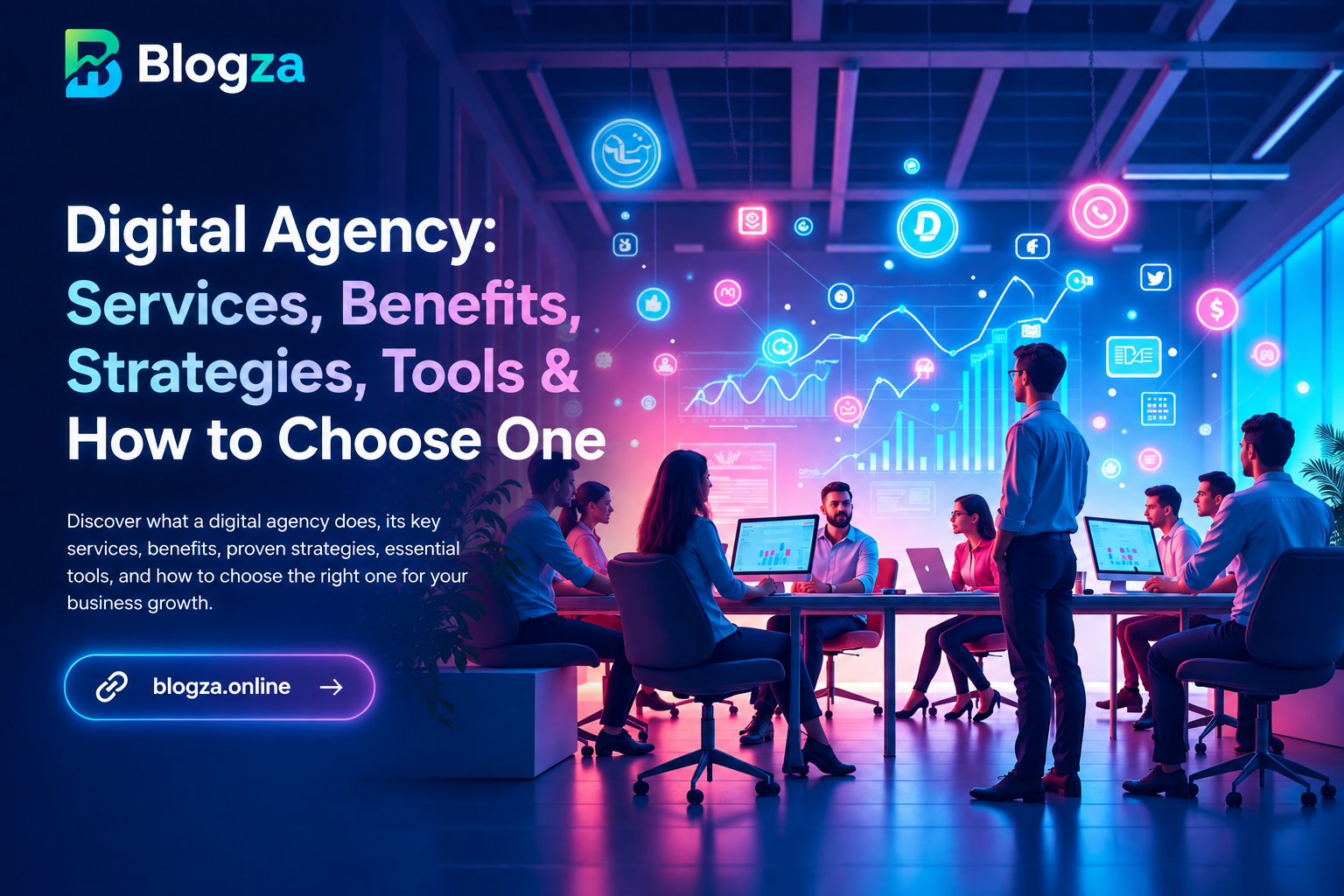
Learn what a digital agency does, its services, benefits, strategies, tools, SEO role, AI Search, and how to choose the right agency.
Table of Contents
What Is a Digital Agency
A digital agency is a company or team that provides marketing, technology, creative, or growth services through digital channels. Instead of relying primarily on traditional advertising such as print, television, or billboards, digital agencies help organizations reach customers through websites, search engines, social platforms, email, online advertising, and other internet-based channels.
Some agencies are full-service digital agencies, meaning they provide several services under one team. Others specialize in a particular area, such as SEO, WordPress development, paid advertising, social media, content marketing, ecommerce, or conversion optimization.
For example, an ecommerce business might work with an agency to improve its product pages, research commercial keywords, optimize technical SEO, publish helpful content, run social campaigns, and analyze conversions. A local service business may instead need Google Business Profile optimization, local SEO, a faster website, review management, and location-focused content.
The right model depends on the organization’s goals. A business does not automatically need every digital marketing service simply because an agency offers them.
What Services Does a Digital Agency Provide?
Digital agencies can offer very different services, but several areas appear frequently across the industry.
SEO and Keyword Research
SEO helps websites become easier for search engines to discover, understand, and present to relevant users. A professional SEO strategy normally includes understanding search intent, researching relevant topics and queries, optimizing pages, improving internal linking, addressing technical issues, and developing useful content.
Keyword research is more than finding a high-volume phrase. An agency should consider what the searcher wants to accomplish. Someone searching for “digital agency” may want a definition, while someone searching for “digital agency for small business” may be researching potential providers.
Good keyword research therefore connects queries with actual business goals and content opportunities.
Technical SEO
Technical SEO focuses on the technical aspects that can affect crawling, indexing, accessibility, and website experience. This can include site architecture, redirects, canonicalization, XML sitemaps, robots.txt, mobile usability, structured data, page performance, and indexation issues.
Technical SEO should not be treated as an isolated activity. A technically clean website still needs useful content and a clear value proposition.
Google’s current documentation also emphasizes overall page experience, including mobile usability, secure delivery, Core Web Vitals, and avoiding intrusive experiences.
Content Marketing
Content marketing uses useful information to attract and educate a target audience. Digital agencies may create blog posts, landing pages, guides, comparison articles, case-study content, videos, social posts, email campaigns, or other resources.
Effective content begins with the audience rather than a keyword list. For example, a company selling SEO software could create content explaining technical SEO, keyword research, content optimization, reporting, and common SEO problems.
The strongest content programs usually connect informational content with commercial pages so that readers can naturally move from learning to evaluating a product or service.
Social Media Marketing
Social media marketing helps organizations communicate with audiences on platforms such as LinkedIn, Instagram, Facebook, TikTok, YouTube, and other relevant networks.
An agency may handle content planning, creative production, publishing, community management, paid campaigns, audience research, and performance reporting.
However, businesses should select social platforms based on audience behavior and business objectives rather than attempting to maintain an active presence everywhere.
Website Development and Optimization
Many digital agencies also build or improve websites. Services may include WordPress development, ecommerce development, landing pages, user-experience improvements, conversion optimization, website maintenance, and website redesigns.
A website should make it easy for visitors to understand what the business offers, find important information, navigate between pages, and take the intended action.
For an ecommerce business, that action may be purchasing a product. For a B2B company, it may be requesting a consultation. For an educational website, it could be reading another article or subscribing to an email list.
Local SEO
Local SEO helps businesses improve their visibility for searches connected to a geographic area. It can involve optimizing local business information, location pages, Google Business Profile signals, reviews, local content, citations, and relevant on-page information.
A restaurant, dental clinic, repair company, or local marketing agency may have very different local search requirements from a national ecommerce brand.
The strategy should therefore reflect the company’s service area, physical presence, competition, and customers.
Why Does a Digital Agency Matter?
A digital agency can bring specialized skills and coordinated execution to businesses that do not have all of those capabilities internally.
Digital marketing involves multiple connected disciplines. SEO can bring organic visibility, content can answer customer questions, social media can support awareness and engagement, paid advertising can reach targeted audiences, and analytics can help determine what is producing useful business outcomes.
An agency can also provide an outside perspective. Internal teams may understand their products extremely well but overlook confusing website navigation, unclear messaging, weak landing pages, or content gaps that are obvious to a new visitor.
The value, however, depends on execution. Hiring an agency does not automatically produce traffic, leads, or revenue. Businesses should evaluate the quality of the strategy, communication, implementation, measurement, and ongoing improvement.
How Does a Digital Agency Work?
A professional agency normally starts by understanding the business before recommending tactics.
Discovery and Business Understanding
The agency may review the company’s products or services, target customers, competitors, existing website, previous marketing activity, analytics, and business objectives.
This stage is important because the same marketing tactic can produce different results for different businesses.
Research and Audit
An agency may conduct a website audit, technical SEO review, keyword research, competitor analysis, content audit, local SEO review, or analytics assessment.
The purpose is to identify problems and opportunities rather than immediately implement random changes.
Strategy Development
The agency then develops a plan based on priorities. A strategy might include technical SEO fixes, content development, landing-page improvements, local SEO, link development, paid campaigns, or social media work.
Good strategies distinguish between high-priority problems and tasks that can wait.
Implementation
Implementation is where recommendations become actual changes. Depending on the contract, the agency may create content, optimize pages, configure campaigns, improve websites, publish social posts, or provide instructions for an internal team.
Measurement and Refinement
Digital marketing should be monitored over time. Agencies may use analytics, Search Console, advertising platforms, CRM data, ranking information, conversion data, and other reporting systems.
The objective is not simply to produce a monthly report. The data should help determine what should be improved next.
Digital Agency vs In-House Marketing Team
An in-house team works directly within the company, while a digital agency works as an external partner.
An in-house team can develop deep knowledge of the company’s products, customers, and internal processes. An agency may provide access to broader specialist expertise without requiring the company to hire every specialist as a full-time employee.
There is also a hybrid approach. A business might keep strategy and brand management internally while using an agency for technical SEO, content production, paid advertising, or web development.
The choice depends on budget, internal expertise, workload, complexity, and the level of control the company wants.
How to Choose a Digital Agency
Choosing an agency should involve more than comparing service packages.
Check Relevant Experience
Look for experience relevant to your business model and goals. An agency specializing in ecommerce SEO may have a different skill set from one focused on local service businesses.
Understand the Strategy
Ask what the agency plans to do and why. Be cautious of explanations based entirely on vague promises such as “secret techniques,” guaranteed rankings, or instant results.
SEO and digital marketing involve many variables, and no legitimate agency can guarantee a particular Google ranking.
Review Communication and Reporting
Ask how often you will receive updates, which metrics will be reported, who will be responsible for the work, and how strategic decisions will be explained.
A useful report should help a business understand progress and make decisions rather than simply display large numbers.
Check What You Actually Need
Do not purchase every service simply because it appears in a package. A small local company may need local SEO and conversion-focused website improvements more urgently than an extensive international SEO program.
Ask About Ownership
Before signing, clarify who owns the website, content, advertising accounts, analytics properties, domains, creative assets, and other important digital assets.
This is especially important when an agency manages accounts on behalf of a business.
Digital Agency Strategies for Modern Search
Search is increasingly conversational and multimodal, so agencies need to create content that works for people across different search experiences.
SEO and Semantic Search
Modern SEO should organize information around topics and user needs rather than repeating one keyword throughout a page.
For a page about digital agencies, related concepts could include digital marketing services, SEO agency, content marketing, web development, social media marketing, online advertising, analytics, local SEO, and conversion optimization.
The goal is to create a complete and understandable resource rather than artificially increasing keyword frequency.
AEO and Conversational Search
Answer Engine Optimization, or AEO, focuses on making useful information easy for answer-oriented systems and users to understand.
Clear definitions, direct answers, descriptive headings, structured explanations, examples, and concise factual passages can make content easier to interpret.
This does not mean writing content specifically to manipulate an AI system. The underlying principle is straightforward: answer genuine questions clearly and provide enough context to support the answer.
GEO and AI Search
Generative Engine Optimization, commonly abbreviated as GEO, is often used to describe efforts to improve the visibility or usefulness of content in generative search experiences.
There is no reliable shortcut that guarantees inclusion in AI-generated answers. Google states that its generative AI features use its core Search systems, which means foundational SEO practices remain important.
Google’s current documentation also explains that its AI search experiences can surface links and sources, reinforcing the importance of creating accessible, useful, trustworthy web content.
Tools a Digital Agency May Use
The exact toolset varies by agency, but common categories include:
- Google Search Console for search performance and indexing information
- Google Analytics for website and user behavior analysis
- Google Business Profile for local business presence
- Keyword research and SEO platforms
- Website crawling and technical SEO tools
- Content research and optimization tools
- Social media management platforms
- Advertising platforms
- CRM and marketing automation systems
- Website platforms such as WordPress
- Design and creative tools
- Reporting and dashboard software
Tools are useful for collecting and analyzing information, but they do not replace strategy. Two agencies can use the same SEO platform and produce very different results because their research, prioritization, implementation, and interpretation differ.
Common Digital Agency Mistakes
One common mistake is focusing on vanity metrics. Website traffic, impressions, followers, or rankings can be useful indicators, but they do not always represent business value.
Another mistake is publishing large amounts of low-value content simply because keywords are available. Search engines increasingly emphasize useful, people-first experiences, while Google’s spam policies also apply to generative AI responses in Search.
Agencies can also make mistakes by ignoring technical problems, failing to understand search intent, targeting overly broad keywords, neglecting conversion optimization, or using the same strategy for every client.
Poor communication is another important problem. Even technically strong work can become ineffective if the client does not understand priorities, progress, responsibilities, or expected timelines.
Latest Digital Marketing Trends
Digital marketing continues to move toward more integrated search, content, data, and AI experiences.
AI-assisted search is one important development. Google’s documentation now provides guidance specifically for generative AI features in Search, while emphasizing that established SEO fundamentals remain relevant.
Another development is the increasing importance of content that demonstrates genuine expertise and provides useful context. Agencies should focus on original insights, accurate information, clear authorship where appropriate, strong sources, and practical examples instead of producing large volumes of generic text.
Search presentation is also becoming more diverse. Google currently documents AI features, featured snippets, preferred sources, images, local business results, and other search appearances as separate areas of Search.
Businesses should therefore build a strong digital presence rather than optimizing exclusively for one search-result format.
Digital Agency Skills and Career Opportunities
Digital agencies also create opportunities for people developing practical digital skills.
SEO specialists may work on keyword research, on-page optimization, technical SEO, internal linking, content strategy, and Search Console analysis. Content specialists may research topics and create articles, landing pages, email content, or social media material.
Other roles include PPC specialists, social media managers, web developers, WordPress specialists, graphic designers, analytics professionals, account managers, and digital marketing strategists.
Beginners do not necessarily need to master every area. Building strong skills in one practical discipline—such as WordPress, SEO, content marketing, analytics, or social media—can provide a foundation for broader digital marketing work.
Frequently Asked Questions
What does a digital agency do?
A digital agency helps businesses with online marketing, websites, search visibility, content, social media, advertising, analytics, or related digital services. The exact services depend on the agency’s specialization.
What is the difference between a digital agency and an SEO agency?
A digital agency may provide multiple services such as SEO, social media, web development, content marketing, and advertising. An SEO agency generally focuses primarily on improving organic search visibility and related search optimization activities.
Is hiring a digital agency worth it for a small business?
It can be useful when a small business lacks specific digital skills or needs additional execution capacity. The decision should depend on business objectives, available budget, internal capabilities, and whether the proposed services address real problems.
How much does a digital agency cost?
There is no single standard price. Costs vary according to services, project complexity, market, agency experience, workload, and contract structure. Businesses should compare the scope of work rather than comparing prices alone.
Can a digital agency guarantee Google rankings?
A responsible agency should not promise a specific Google ranking. Search results depend on many systems and competitive factors that an agency cannot fully control. A better approach is to define measurable objectives and improve the factors within the business’s control.
Does AI Search make SEO unnecessary?
No. Google states that its generative AI Search features are built on its existing Search systems, so SEO fundamentals remain relevant. Businesses should focus on useful, accessible, trustworthy content and sound technical foundations.
Should a digital agency handle social media and SEO together?
It can make sense when both channels support the same business objectives and audience strategy. However, businesses should choose services based on actual needs rather than assuming every channel must be managed simultaneously.
Is an agency better than hiring freelancers?
Neither model is automatically suitable for every business. An agency may provide a broader team and multiple disciplines, while a freelancer may provide specialized expertise and a more direct working relationship. The appropriate choice depends on the project, scope, budget, and required skills.

Conclusion
A digital agency can help a business build and manage its online presence across search, content, websites, social media, advertising, analytics, and other digital channels. The most useful agency relationships are based on clear objectives, relevant expertise, transparent communication, measurable work, and a strategy connected to the actual needs of the business.
For modern digital marketing, SEO remains important, but it should be part of a broader approach. Businesses should understand search intent, create useful content, maintain technically accessible websites, improve user experience, and adapt to changing search behaviors. Google’s current guidance confirms that established SEO practices continue to matter as generative AI features become part of Search.
Whether a business works with a full-service digital agency, a specialist agency, freelancers, or an internal team, the fundamental principle remains the same: invest in digital activities that help real users and support measurable business goals. A strong digital strategy is not about chasing every new platform or trend. It is about understanding customers, solving their problems, communicating value clearly, and continuously improving the digital experience.