
Learn how technical SEO services improve crawling, indexing, site speed, architecture, AI search visibility, and overall SEO performance.
Table of Contents
What Are Technical SEO Services?
Technical SEO services are professional activities designed to improve the technical structure and search accessibility of a website. The objective is not simply to make a website “technically perfect.” Instead, the goal is to remove technical barriers that can prevent valuable content from being discovered, processed, indexed, or presented effectively in search.
A technical SEO specialist may examine a website’s robots.txt file, XML sitemap, URL structure, canonical tags, redirects, HTTP status codes, internal links, JavaScript rendering, structured data, page performance, mobile experience, duplicate content, international SEO signals, and indexation patterns.
For example, imagine an online store has 10,000 product URLs but only 2,000 are genuinely valuable. If filters, sorting parameters, session URLs, and duplicate versions create thousands of unnecessary URLs, search engines may spend resources processing pages that do not provide unique value. Technical SEO can help establish a cleaner architecture and clearer signals about which pages matter.
Why Technical SEO Matters
Search engines need to access and interpret your website before your content can compete effectively in organic search. Technical SEO therefore supports the entire SEO process rather than functioning as a separate activity.
A technically healthy website can make it easier for search engines to discover important URLs, understand relationships between pages, identify preferred versions of duplicate content, and process JavaScript-generated content. It can also improve the experience for visitors by addressing issues such as slow pages, broken links, confusing navigation, and poor mobile usability.
Technical SEO is particularly important for larger websites, ecommerce stores, publishers, SaaS platforms, multilingual websites, and JavaScript-heavy applications. However, smaller websites can benefit too. A small business website with only 30 important pages still needs those pages to be crawlable, indexable, internally connected, secure, and accessible.
How Technical SEO Works
Technical SEO generally follows a cycle of audit, prioritization, implementation, validation, and monitoring.
The first step is an audit to identify technical problems and opportunities. The next step is prioritization because not every warning from an SEO crawler deserves immediate attention. A missing image attribute and a website-wide noindex directive do not have the same business impact.
Implementation may involve developers, content teams, designers, hosting providers, or SEO specialists. After changes are made, the site should be tested again. Search Console, crawling tools, browser testing, log analysis, and URL inspection can help confirm whether important problems have actually been resolved.
The process should then continue through monitoring. Technical SEO is not a one-time task because websites change constantly. New plugins, templates, products, redirects, JavaScript frameworks, migrations, and content updates can introduce new technical problems.
Technical SEO Audit
A technical SEO audit provides a structured assessment of how a website can be crawled, rendered, indexed, and understood.
A professional audit commonly reviews:
- Crawlability and indexability
- Robots.txt directives
- XML sitemaps
- HTTP status codes
- Redirect chains
- Broken URLs
- Canonicalization
- Duplicate content
- Internal linking
- URL architecture
- JavaScript rendering
- Mobile usability
- Core Web Vitals
- HTTPS and security
- Structured data
- Pagination and faceted navigation
- International SEO
- Orphan pages
- Image and media accessibility
- Search Console indexing issues
The most valuable part of an audit is not the number of issues discovered. It is the explanation of which problems matter, why they matter, and what should be done first.
Crawlability and Indexability
Crawlability describes whether search engine crawlers can access URLs and discover their content. Indexability concerns whether those pages are eligible to be included in a search engine’s index.
A page can be technically accessible but still excluded from indexing. Common causes include an accidental noindex directive, authentication requirements, canonicalization problems, poor internal linking, or other technical signals.
Robots.txt should also be handled carefully. Blocking a URL in robots.txt prevents crawling, but it should not be treated as a universal replacement for noindex. Technical SEO specialists need to understand the difference between preventing crawling and controlling indexing.
Google’s JavaScript SEO documentation explains that Google processes JavaScript through crawling, rendering, and indexing stages. This is important for modern websites where important page content is generated or modified through JavaScript.
XML Sitemaps
An XML sitemap helps search engines discover important URLs on a website. It is particularly useful for large websites, newly launched sites, websites with complex architectures, and sites containing pages that may not be easily discovered through internal links.
A sitemap should not simply contain every URL generated by a website. It should generally represent the URLs that you want search engines to discover and consider.
Technical SEO services can include reviewing sitemap accuracy, removing inappropriate URLs, checking response codes, monitoring indexation, and ensuring that important canonical URLs are represented appropriately.
A sitemap cannot force a page into Google’s index, but it can provide useful discovery and organizational signals.
Canonicalization and Duplicate URLs
Duplicate or near-duplicate URLs can make it difficult for search engines to determine which version should represent a piece of content.
For example, the same product could potentially be accessible through multiple URL variations created by filters or tracking parameters. Canonicalization helps communicate the preferred representative URL.
Google describes canonicalization as the process of selecting a representative URL from a group of duplicate or substantially similar pages. Importantly, a canonical tag is a hint rather than an absolute command; Google can select a different canonical when its systems determine another URL is more appropriate.
A technical SEO specialist therefore checks canonical tags alongside redirects, internal links, sitemaps, HTTPS versions, and the actual similarity of pages.
Website Architecture and Internal Linking
Website architecture determines how information is organized and how users and crawlers move between pages.
A strong architecture makes important content easy to discover. Category pages can connect to relevant subcategories and products, while blog content can connect naturally to service pages and deeper educational resources.
Internal links also help establish relationships between topics. For a digital marketing website, an article about keyword research might naturally link to guides about on-page SEO, technical SEO, content strategy, and SEO tools.
Technical SEO services may identify orphan pages—pages with few or no meaningful internal links—and recommend changes to improve the site’s information architecture.
Core Web Vitals and Page Experience
Website performance is an important part of technical SEO and user experience. Core Web Vitals provide standardized metrics for aspects of loading performance, responsiveness, and visual stability.
However, improving technical performance should not become a race to achieve arbitrary scores while ignoring the visitor’s actual experience.
A useful performance strategy includes optimizing large images, reducing unnecessary JavaScript, improving server response time, controlling layout shifts, using effective caching, and reviewing third-party scripts.
For example, an ecommerce site may load multiple analytics, advertising, chat, review, and personalization scripts. Each tool may have a legitimate purpose, but collectively they can increase page complexity. Technical SEO and development teams can evaluate which resources are genuinely necessary.
Mobile SEO
Mobile optimization is no longer optional for modern websites. Technical SEO should verify that pages work correctly across common mobile screen sizes and that important content, navigation, links, forms, images, and interactive elements remain usable.
A responsive design is only part of mobile SEO. Specialists should also examine mobile page performance, viewport configuration, content parity, intrusive elements, JavaScript behavior, and whether important resources are accessible.
Testing should focus on real user journeys rather than only automated scores. A mobile visitor trying to contact a local business, purchase a product, or read an article should be able to complete the task without unnecessary friction.
JavaScript SEO
Modern websites frequently use JavaScript frameworks and dynamic components. JavaScript itself is not inherently bad for SEO, but implementation can create technical challenges.
Problems can occur when important content exists only after complex client-side execution, links are not implemented in crawlable ways, metadata changes unexpectedly, or rendering behavior differs between users and crawlers.
Google can process JavaScript, but developers still need to ensure that important content and links are available in the rendered page. Google recommends testing JavaScript-powered pages and reviewing the rendered HTML when diagnosing problems.
Technical SEO services for JavaScript websites may therefore include rendering analysis, server-side rendering or static generation recommendations, metadata testing, structured data validation, and examination of dynamically generated content.
Structured Data and Schema Markup
Structured data provides machine-readable information about page content. Depending on the content type and Google’s supported features, appropriate structured data can help search engines understand entities and page information.
Common schema types include Organization, LocalBusiness, Article, Product, BreadcrumbList, Event, and others where applicable.
The important point is relevance and accuracy. Adding every possible schema type does not automatically improve rankings. Structured data should accurately describe visible or otherwise eligible page content and follow search engine guidelines.
Technical SEO specialists can implement or validate JSON-LD, identify errors, and ensure that markup remains synchronized with the actual page.
Technical SEO and AI Search
AI Overviews, AI Mode, and other generative search experiences have increased interest in AEO and GEO. However, technical SEO remains part of the foundation.
Google’s 2026 guidance explicitly states that established SEO best practices continue to matter for generative AI search features. Google also emphasizes the importance of technically accessible websites and indexed content.
This means businesses should not search for a secret “AI ranking trick.” Instead, they should build websites that are technically accessible and publish useful, original information that genuinely satisfies user needs.
For AI-oriented search visibility, technical foundations can include:
- Crawlable and indexable content
- Clear site architecture
- Descriptive page titles and headings
- Strong internal linking
- Accessible text and media
- Accurate structured data
- Fast, usable pages
- Clear entity and organization information
- High-quality, non-commodity content
Google’s current documentation also clarifies that llms.txt is not required for Google Search and does not provide a positive or negative ranking effect in Google Search.
AEO and GEO: Where Technical SEO Fits
Answer Engine Optimization and Generative Engine Optimization are often discussed as if they replace traditional SEO. They do not.
AEO focuses on making information useful and understandable for answer-oriented search experiences, while GEO is commonly used to describe optimization for generative AI discovery. The terminology varies across the industry, so businesses should focus on practical outcomes rather than labels.
Technical SEO supports these efforts by ensuring that important information can be accessed and processed. Content quality remains critical. A technically perfect page with thin or unhelpful information is unlikely to become a strong resource simply because it has optimized metadata.
Local SEO and Technical Foundations
Local businesses also benefit from technical SEO. A local service website needs clear location information, crawlable service pages, consistent business details, mobile usability, and a logical website structure.
For example, a dermatology clinic might have separate pages for skin allergy treatment, hair loss treatment, acne treatment, and its main clinic location. Internal linking can connect these pages while structured data and clear contact information can help search engines understand the business.
Technical SEO does not replace a well-managed Google Business Profile or local content strategy. Instead, it supports the website component of a broader local SEO campaign.
Benefits of Technical SEO Services
Professional technical SEO services can provide several practical benefits:
Better crawl efficiency: Search engines can discover important URLs more effectively when the site’s architecture is clean.
Improved indexation control: Technical fixes can reduce accidental noindex directives, duplicate URLs, and other indexation problems.
Stronger website architecture: Clear internal linking helps users and crawlers navigate important content.
Improved performance: Performance optimization can create a faster, more usable experience.
Better migration management: Redirects, URL mapping, canonicalization, and testing can reduce avoidable problems during redesigns or domain changes.
Stronger SEO foundations: Content marketing and keyword targeting become more effective when technical barriers are reduced.
Google’s site-migration guidance recommends preparing and testing the new site, mapping old URLs to new ones, and configuring appropriate redirects when URLs change.
Technical SEO Tools
A technical SEO workflow can involve several tools, each serving a different purpose.
Google Search Console is useful for monitoring search performance, indexing information, URL inspection, and technical search-related reports.
Google Analytics helps analyze user behavior and conversions, although it is not primarily a technical SEO auditing tool.
Screaming Frog SEO Spider can crawl websites and identify issues involving links, redirects, metadata, canonicals, response codes, and other technical elements.
Ahrefs and Semrush can support technical audits alongside keyword research, backlink analysis, competitive research, and broader SEO workflows.
PageSpeed Insights and browser developer tools can help investigate performance and page behavior.
Rich Results Test and structured-data testing workflows can help validate eligible structured data implementations.
The right tool is less important than knowing how to interpret its findings. Automated tools can report hundreds or thousands of warnings, but an experienced SEO professional must distinguish critical problems from low-priority recommendations.
Common Technical SEO Mistakes
One common mistake is trying to fix every audit warning without considering business impact. This creates busywork rather than meaningful SEO improvement.
Another mistake is changing URLs without planning redirects and internal links. URL migrations can create broken links, lost signals, and confusing user journeys if handled poorly.
Overusing canonical tags is another issue. A canonical should not be used as a universal solution for every duplicate-looking URL. The site’s content structure and URL relationships should first be understood.
Websites can also accidentally block important pages through robots.txt or noindex directives. Similarly, developers may launch redesigned websites containing staging URLs, temporary directives, or incomplete metadata.
Finally, businesses sometimes focus heavily on technical scores while neglecting content quality. Technical SEO should support useful content, not replace it.
How to Choose Technical SEO Services
When comparing technical SEO agencies or freelancers, look for a process rather than promises.
A credible provider should explain how they will audit the website, prioritize issues, communicate recommendations, implement or coordinate fixes, and measure results.
Ask whether the service includes:
- Full technical SEO audit
- Crawlability and indexability analysis
- Search Console review
- Sitemap and robots.txt checks
- Canonical and duplicate-content analysis
- Redirect review
- Internal-linking analysis
- JavaScript SEO review when relevant
- Structured data validation
- Performance recommendations
- Migration support when needed
- Ongoing monitoring
Be cautious of providers promising guaranteed Google rankings or claiming a proprietary shortcut that can bypass Google’s normal ranking systems. SEO outcomes depend on competition, content quality, website quality, authority, search demand, and many other factors.
Latest Technical SEO Trends in 2026
Technical SEO in 2026 is increasingly connected with AI-powered search, JavaScript applications, structured data, performance, and website accessibility.
Google has continued updating its Search documentation around generative AI features, AI Mode, AI Overviews, and technical implementation. Its current guidance emphasizes that normal SEO fundamentals remain relevant rather than introducing a separate set of guaranteed AI ranking factors.
Google also removed documentation for the FAQ rich result feature in 2026 because that feature is no longer shown in Google Search. This is a useful reminder that structured-data strategies should be based on currently supported search features rather than old SEO checklists.
For SEO professionals, the broader trend is clear: technical SEO is becoming less about isolated “SEO tricks” and more about building websites that are accessible, understandable, performant, and resilient across changing search interfaces.
FAQs About Technical SEO Services
What do technical SEO services include?
Technical SEO services usually include website crawling and indexing analysis, sitemap and robots.txt reviews, canonicalization, redirects, internal linking, site architecture, JavaScript SEO, structured data, performance, mobile usability, and technical monitoring.
Is technical SEO important for small websites?
Yes. Small websites can still have problems such as broken links, incorrect canonicals, slow pages, accidental noindex directives, poor internal linking, or indexing issues. The scale may be smaller, but the principles remain important.
How often should a technical SEO audit be performed?
The frequency depends on the website. A small, stable website may need periodic audits, while large ecommerce sites, publishers, and frequently updated websites may benefit from continuous monitoring and more regular technical reviews.
Can technical SEO improve Google rankings?
Technical SEO can remove barriers that make it difficult for search engines to crawl, understand, and index a website. However, fixing technical problems does not guarantee higher rankings. Rankings also depend on relevance, content quality, competition, authority, user needs, and Google’s ranking systems.
What is the difference between technical SEO and on-page SEO?
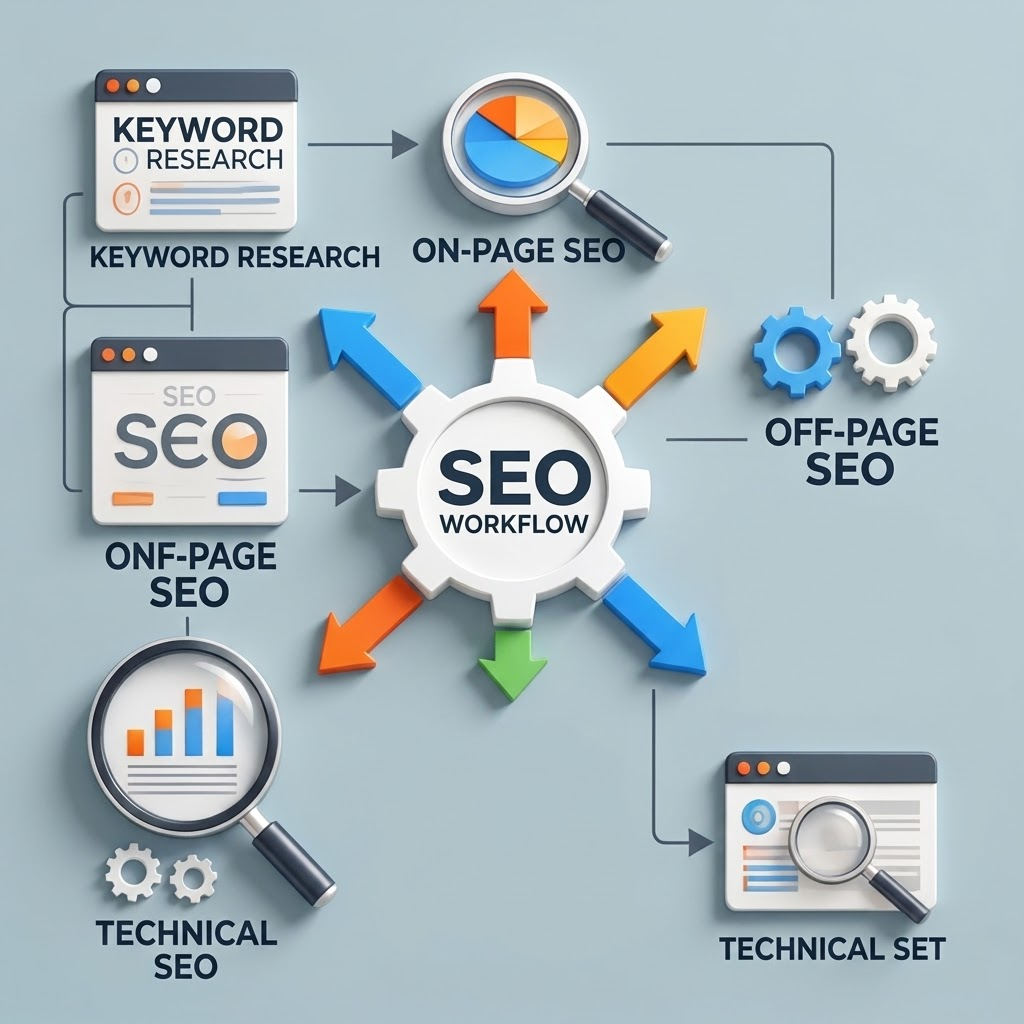
Technical SEO focuses primarily on the website’s technical accessibility, architecture, crawling, indexing, rendering, performance, and related systems. On-page SEO focuses more directly on page content, headings, keywords, search intent, internal links, metadata, and content quality. The two areas work together.
Does technical SEO help AI Overviews and AI Mode?
Technical SEO can support visibility by making content accessible and indexable. Google says that SEO best practices remain relevant to its generative AI search features. However, there is no guaranteed technical “AI ranking hack.”
Are technical SEO services worth paying for?
They can be valuable when a website has complex technical problems, a large number of URLs, JavaScript dependencies, migration requirements, ecommerce architecture, or unexplained organic-search issues. The value depends on whether the service identifies and resolves meaningful problems rather than simply producing automated audit reports.
What is the first step in technical SEO?
Start with a technical audit and establish a baseline. Review crawlability, indexability, Search Console data, important URLs, site architecture, performance, redirects, canonicals, and internal links. Then prioritize problems according to their potential impact on users and search visibility.
Conclusion
Technical SEO services provide the foundation on which broader SEO and digital marketing strategies can operate effectively. From crawlability and indexation to JavaScript rendering, canonicalization, structured data, site architecture, mobile usability, and performance, technical SEO helps create a website that both people and search engines can understand.
The strongest approach is not to chase every automated SEO warning or search for a secret ranking formula. Instead, focus on removing genuine technical barriers, creating a logical website structure, protecting important URLs, improving user experience, and supporting valuable content.
As search continues to evolve through AI Overviews, AI Mode, conversational search, and other discovery experiences, the fundamentals remain important. Google’s current guidance reinforces this point: technically accessible websites and established SEO best practices continue to provide the foundation for visibility across modern Search experiences.
For businesses, marketers, and digital professionals, technical SEO should therefore be treated as an ongoing discipline rather than a one-time checklist. Audit the site, prioritize meaningful problems, implement carefully, validate the changes, and continue monitoring as the website and search ecosystem evolve.



[…] business, this type of model can make sense when internal teams do not have the resources to manage technical SEO, content production, authority development and measurement […]
[…] For example, a web design agency may have clients asking for SEO but may not have an internal technical SEO team, content specialists, outreach professionals, or enough staff to manage ongoing […]
[…] SEO, DAM does not replace keyword research, technical SEO, content optimization, internal linking, structured data, or search analytics. Instead, it supports […]
[…] website, for example, an article about technical SEO could naturally link to related content about technical SEO services, SEO content strategy, keyword research, or local […]