
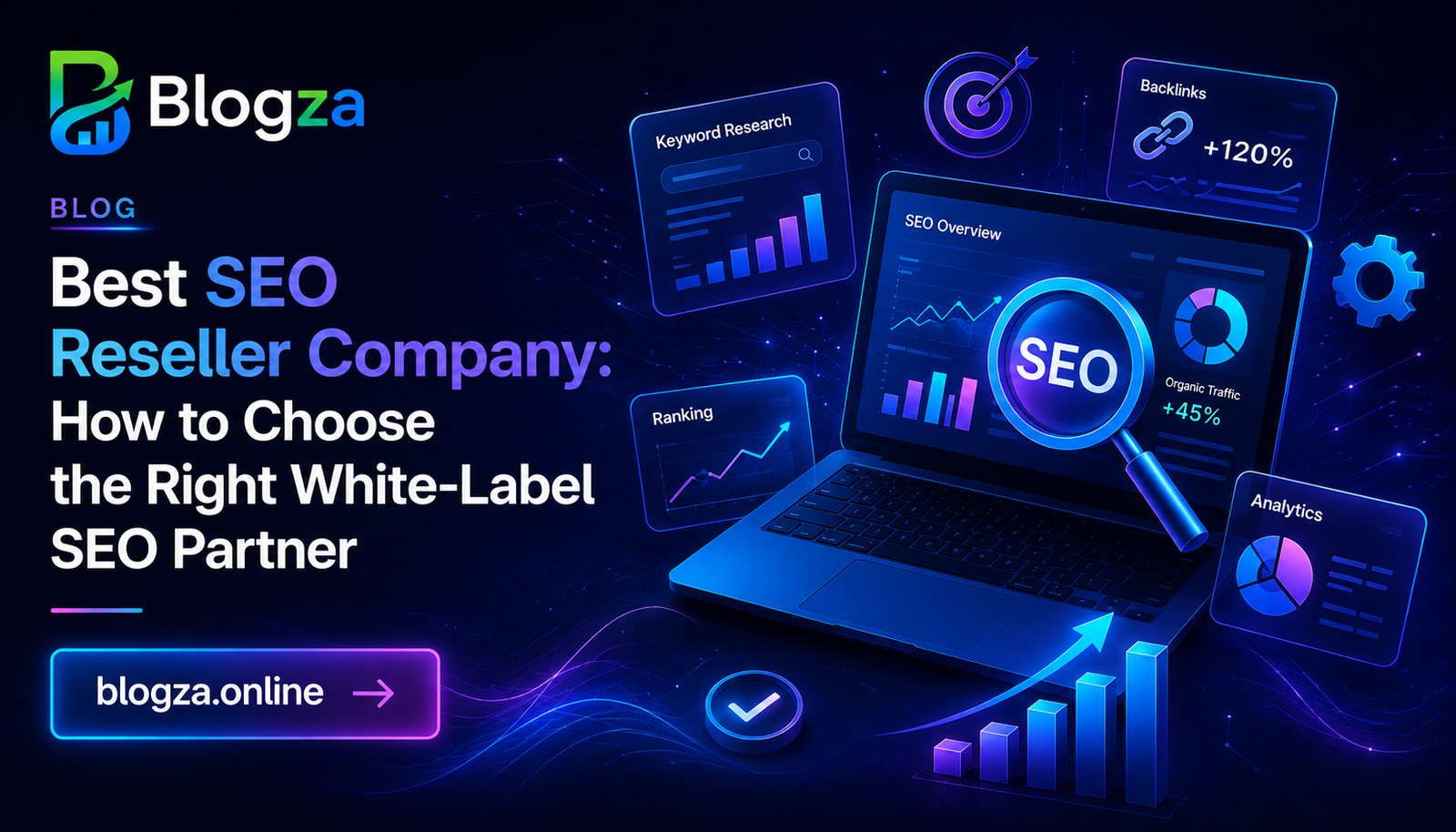
Compare the best SEO reseller company options, white-label services, pricing factors, AI Search capabilities, and tips for choosing a reliable partner.
Table of Contents
What Is an SEO Reseller Company?
An SEO reseller company provides search engine optimization services that another agency can sell to its own customers. The provider performs some or all of the SEO fulfillment, while the reseller manages the client relationship, pricing, positioning, and often the overall strategy.
This model is commonly called white-label SEO or SEO outsourcing. For example, a web design agency may have clients asking for SEO but may not have an internal technical SEO team, content specialists, outreach professionals, or enough staff to manage ongoing campaigns.
Instead of hiring several specialists, the agency can work with a reseller partner. The partner may perform keyword research, technical audits, on-page optimization, content production, local SEO, link building, reporting, and campaign management. The agency then packages those services under its own brand.
A good reseller relationship should feel like an extension of your internal team. The goal is not merely to move tasks to another company. It is to create a reliable fulfillment system that lets your agency sell SEO confidently while maintaining control over the client experience.
Why SEO Reseller Services Matter for Agencies
SEO requires a combination of strategic, technical, analytical, and content skills. A small agency may understand digital marketing well but still struggle to maintain a full SEO department.
Building an internal team can require SEO strategists, technical specialists, content writers, editors, outreach professionals, local SEO specialists, analysts, and account managers. A reseller model can provide access to some of those capabilities without requiring the agency to build every function internally.
The commercial benefit is flexibility. You can accept SEO projects when demand increases, expand your service portfolio, and potentially create recurring revenue without immediately increasing internal headcount.
However, outsourcing does not remove responsibility. Your client still sees your agency as responsible for the campaign. That means you need enough visibility into the provider’s work to explain what is being done and why.
How an SEO Reseller Program Works
A typical white-label SEO workflow begins when your agency signs a client and collects information about its business, audience, competitors, website, locations, products, and goals.
The reseller partner then conducts an initial assessment. Depending on the service package, this may include:
- Website and technical SEO auditing
- Keyword research
- Competitor analysis
- Search-intent mapping
- On-page optimization
- Content planning
- Content creation
- Internal linking
- Local SEO
- Link acquisition
- Performance monitoring
- Monthly reporting
The agency usually determines the retail price charged to the client. The provider charges the agency a wholesale or partner rate.
For example, imagine a digital marketing agency sells an SEO package for $1,200 per month. If the fulfillment cost is $700, the difference is $500 before the agency’s other operating costs. The important point is that margin is not the same as profit. Account management, sales, client communication, software, revisions, taxes, and overhead also affect profitability.
What Makes the Best SEO Reseller Company?
There is no single provider that is objectively the best for every agency. The right choice depends on your client type, budget, service model, geographic focus, and desired level of control.
Nevertheless, strong SEO reseller companies generally share several characteristics.
Strong SEO fundamentals
The provider should understand the fundamentals of modern SEO rather than relying on a narrow collection of ranking tactics.
Look for capabilities covering keyword research, search intent, technical SEO, content quality, internal linking, structured data where appropriate, local SEO, analytics, and authority development.
Google explains that SEO helps search engines understand content and helps users discover websites through search. It also stresses that there are no secret techniques that automatically guarantee first-place rankings.
A reseller promising guaranteed rankings should therefore be treated cautiously.
Transparent deliverables
Avoid vague packages such as “advanced optimization” without explaining what the client actually receives.
A stronger program defines its work clearly. For example, a monthly campaign might include technical recommendations, content optimization, keyword tracking, content production, local optimization, and reporting.
Clear deliverables make it easier for your sales team to sell the service and for your account managers to explain progress.
White-label reporting
Reporting is one of the most important parts of a reseller relationship.
The dashboard or reports should allow your agency to present campaign information under its own brand where applicable. Reports should focus on meaningful business and SEO indicators rather than overwhelming clients with unnecessary metrics.
Useful reporting can include organic visibility, target queries, landing-page performance, conversions, technical issues, content activity, local visibility, and completed work.
Quality control
A reseller may produce hundreds of pages or acquire large numbers of links, but volume alone does not establish quality.
Your partner should have editorial review, technical checks, campaign QA, and a process for correcting errors. You should also be able to review samples before committing a large portion of your client portfolio.
Reliable communication
A provider can have excellent SEO skills but still become a poor partner if communication is slow.
Before signing, ask who will manage your account, how issues are escalated, how revisions are handled, and how quickly your team can expect responses.
Best SEO Reseller Companies to Consider
The following providers represent different approaches to white-label SEO. They should be treated as a shortlist for evaluation, not as an absolute ranking. Your agency should test the actual service before selecting a long-term partner.
SEOReseller
SEOReseller is a full-service white-label provider offering SEO, local SEO, ecommerce SEO, content, link building, PPC, and other digital marketing services.
Its reseller offering includes white-label reporting, account management, and campaign support. The company also describes technical SEO, content optimization, website audits, and link building among its services.
This type of provider may suit agencies that want a broader fulfillment relationship rather than purchasing only individual SEO tasks.
The HOTH
The HOTH provides private-label SEO services including link building, content, and managed SEO.
Its reseller program emphasizes white-label reports, a centralized dashboard, reseller resources, and the ability to purchase different services rather than necessarily outsourcing every part of an SEO campaign.
This modular approach can be useful for agencies that already handle some SEO internally and only need support with particular deliverables.
Boostability
Boostability offers several partnership models, including reseller and white-label options.
Its current reseller program describes different levels of agency involvement, from models where the agency manages client communication to fully white-label fulfillment where the provider handles onboarding, strategy, fulfillment, reporting, and communication under the agency’s brand.
This makes the company worth considering when an agency wants to choose how much of the client relationship remains internal.
FATJOE
FATJOE is commonly positioned as a fulfillment-focused provider for services such as content and link building. It can be relevant for agencies that do not need a complete managed SEO department but want to outsource specific recurring tasks.
The important question is whether its available services match your campaign requirements. A specialized provider can sometimes be a better choice than a full-service platform when your agency already has strong strategy and account-management capabilities.
DashClicks and similar platforms
Platforms such as DashClicks can appeal to agencies that want fulfillment combined with reporting, automation, dashboards, or other agency infrastructure.
This model differs from a traditional specialist SEO supplier. Instead of simply purchasing SEO deliverables, an agency may use the platform as part of its wider operational system.
Before choosing this approach, determine whether you actually need the additional software infrastructure. Paying for features your team rarely uses can reduce the economic advantage of outsourcing.
SEO Services Your Reseller Partner Should Cover
Keyword research and search intent
Keyword research remains an important foundation, but modern SEO should go beyond collecting high-volume phrases.
A capable reseller should understand what searchers are trying to accomplish. Informational searches may require educational content, while commercial searches may require comparison pages, service pages, product information, or detailed buying guidance.
A strong campaign connects keywords with relevant pages rather than forcing one phrase repeatedly onto every page.
Technical SEO
Technical SEO focuses on making a website accessible, crawlable, understandable, and technically sound.
Depending on the website, a reseller may review indexing, crawlability, redirects, canonicalization, XML sitemaps, structured data, mobile usability, page performance, JavaScript rendering, duplicate content, and internal linking.
Google recommends ensuring that search engines can access and understand important page resources and recommends using tools such as URL Inspection to understand how Google sees a page.
Content marketing
Content should support real customer needs instead of existing only to target keywords.
A good reseller should be able to create or optimize content around search intent, topical relevance, expertise, and the user’s decision-making process.
Google’s people-first guidance specifically encourages original, useful, reliable content that provides substantial value rather than simply rewriting information found elsewhere.
Local SEO
For businesses serving specific cities or regions, local SEO can be a major component of the campaign.
Services may include Google Business Profile optimization, local landing pages, citations, location-based content, reputation-related workflows, and local keyword research.
The exact strategy should depend on the business rather than applying the same local SEO checklist to every client.
Link building and authority development
Link acquisition can help establish authority, but quality and relevance matter more than chasing arbitrary quantities.
Ask your reseller how links are sourced, whether publishers are reviewed, how relevance is assessed, and what happens if a placement is unsuitable.
Avoid partners that cannot explain their link-building methodology or that promise large numbers of links without meaningful quality controls.
AI Search, AEO and GEO in SEO Reseller Services
Search is increasingly incorporating generative AI experiences. This has created interest in AI Search Optimization, Answer Engine Optimization (AEO), and Generative Engine Optimization (GEO).
These terms describe efforts to make information useful and discoverable in systems that provide direct answers, summaries, recommendations, and citations.
However, agencies should avoid selling “AI ranking hacks.” Google states that the same foundational SEO best practices remain relevant for AI Overviews and AI Mode and that there are no additional technical requirements specifically for appearing in those features.
Google’s current guidance also explains that AI features can use multiple related searches to explore subtopics and identify supporting web pages.
Therefore, an AI-ready reseller strategy should focus on fundamentals: technically accessible websites, useful content, clear entities and topics, strong topical coverage, accurate information, and content that directly satisfies complex user questions.
Tools a Good SEO Reseller Should Understand
Your reseller does not necessarily need to provide every SEO tool, but its team should be comfortable working with professional platforms.
Depending on the campaign, relevant tools may include:
- Google Search Console
- Google Analytics
- Google Business Profile
- Screaming Frog
- Semrush
- Ahrefs
- SE Ranking
- PageSpeed Insights
- Google Trends
- Looker Studio
- Structured-data testing tools
The important issue is not the number of subscriptions. It is whether the provider uses data to make sensible decisions.
A monthly report filled with rankings but lacking interpretation is less valuable than a concise report explaining what changed, why it changed, what was completed, and what should happen next.
How to Compare SEO Reseller Companies
Create a simple evaluation framework before contacting providers.
| Evaluation Area | What to Check |
|---|---|
| SEO capability | Technical, on-page, content, local and authority expertise |
| White-labeling | Reports, dashboards and client-facing assets |
| Communication | Account manager and escalation process |
| Deliverables | Clearly defined monthly work |
| Quality control | Editorial and technical review |
| Reporting | Useful data and actionable explanations |
| Scalability | Ability to handle additional clients |
| Pricing | Wholesale cost and realistic margins |
| Flexibility | Custom campaigns and revisions |
| Contract terms | Minimum commitments and cancellation rules |
| AI Search | Understanding of modern search without exaggerated promises |
| Security | Appropriate access and account controls |
Do not select a provider solely because it has the lowest wholesale price. Cheap fulfillment can become expensive when your team has to rewrite content, correct technical errors, explain poor reports, or manage unhappy clients.
Common SEO Reseller Mistakes
Choosing based only on price
Low cost does not automatically mean high value. A cheap package can produce poor content, weak links, limited strategy, or excessive account-management work.
Calculate the total cost of delivery, including your team’s time.
Selling unrealistic results
Do not promise a client that a reseller will guarantee first-page rankings.
Google itself states that there are no secrets that automatically rank a website first, and SEO changes can take different amounts of time to show an effect.
A better sales process establishes measurable objectives while explaining that organic search performance depends on the website, competition, content, technical condition, authority, market, and many other factors.
Publishing large amounts of low-value AI content
AI can assist with research, outlining, editing, analysis, and other workflows, but using automation to produce large volumes of unoriginal pages primarily to manipulate rankings creates risk.
Google’s spam policies specifically identify scaled content abuse as the production of many pages primarily for manipulating search rankings rather than helping users. This applies regardless of whether the content was generated by AI or another method.
Ignoring client ownership and access
Your agency should understand who owns accounts, websites, analytics properties, Search Console properties, content, and other assets.
Avoid operational arrangements where your agency becomes dependent on a provider simply because you cannot access essential client data.
Using identical strategies for every client
A dentist, ecommerce store, SaaS company, local restaurant, law firm, and B2B manufacturer have different search journeys.
The reseller should adapt strategy according to industry, competition, audience, geography, conversion goals, and website maturity.
A Practical SEO Reseller Strategy for Agencies
A strong agency can divide responsibilities instead of outsourcing everything.
Your agency can retain ownership of discovery, client communication, positioning, business goals, and high-level strategy. The reseller can handle repeatable technical execution, content production, audits, local SEO tasks, or other agreed fulfillment.
This hybrid model gives the agency more control while still reducing production pressure.
For example, your agency might perform the initial SEO audit and client interview, then send the technical implementation and content production to the reseller. Your strategist reviews the completed work before it reaches the client. This creates an additional quality-control layer and helps your team understand the campaign.
Over time, you can measure which tasks are most profitable to outsource and which are better handled internally.
Latest SEO Reseller Trends in 2026
The SEO reseller market is moving toward broader digital visibility rather than isolated keyword ranking.
One important trend is the integration of SEO with AI Search. Agencies increasingly need to explain visibility across traditional search results and AI-driven answer experiences. Google’s official documentation confirms that AI Overviews and AI Mode still depend on core Search systems and fundamental SEO practices.
Another trend is greater emphasis on quality and originality. Google’s current spam documentation explicitly addresses scaled content abuse, while its people-first guidance stresses original, useful, reliable content.
Agencies are also looking for more integrated fulfillment. Instead of purchasing isolated backlinks or articles, some agencies want partners that can combine technical SEO, content, local optimization, reporting, and strategic support.
The result is a more demanding reseller market. Agencies increasingly need partners that can demonstrate what they actually do rather than simply sell a large package of SEO activities.
FAQs About the Best SEO Reseller Company
What is the best SEO reseller company?
There is no universally best provider. The best SEO reseller company is the one that matches your agency’s client types, budget, required services, communication needs, quality standards, and fulfillment model. Shortlist several providers and test their work before scaling.
Is white-label SEO profitable?
It can be profitable when wholesale fulfillment costs, retail pricing, account-management time, revisions, software, and other operating costs are carefully controlled. Profitability depends on your business model rather than the reseller’s markup alone.
What services should an SEO reseller provide?
A strong provider may offer keyword research, technical SEO, on-page optimization, content marketing, local SEO, link building, reporting, and campaign strategy. You should select services based on your clients rather than buying every available service.
Is SEO outsourcing safe for an agency?
SEO outsourcing can work well when the provider uses ethical practices, provides transparent reporting, protects client data, and communicates clearly. Agencies should review samples, contracts, access controls, deliverables, and link-building practices before signing.
Should I choose a cheap SEO reseller?
Price should be only one factor. A very cheap provider may create additional work for your team if the quality is poor. Compare total delivery cost, service quality, communication, reporting, and client retention potential.
Can SEO resellers help with AI Search?
Some providers now market AI-ready SEO services, but agencies should avoid claims of guaranteed AI visibility. Google says the foundational SEO practices used for traditional Search remain relevant to AI Overviews and AI Mode.
How long does reseller SEO take to show results?
There is no universal timeline. Google notes that some changes may be reflected within hours while others can take several months, and it recommends allowing time to assess whether changes are beneficial.
Should I test an SEO reseller before using them for all clients?
Yes. A paid pilot with one suitable client can reveal the provider’s communication quality, technical ability, content standards, reporting, revision process, and reliability before you expose your wider client portfolio to the relationship.

Conclusion
Finding the best SEO reseller company is ultimately a process of evaluating fit, quality, transparency, and operational reliability. The right provider should help your agency expand its SEO capabilities without forcing you to sacrifice control over the client experience.
Start by defining exactly what you want to outsource. Then compare providers based on technical SEO expertise, keyword research, content quality, local SEO, authority development, reporting, communication, white-label capabilities, pricing, and scalability.
Do not choose a partner simply because it promises fast rankings or offers the largest package. Google’s current guidance continues to emphasize people-first content, technical accessibility, useful information, and compliance with Search policies.
In 2026, a strong SEO reseller should also understand how search is evolving toward AI-powered experiences without pretending that there is a secret formula for AI visibility. Google’s guidance is clear that foundational SEO remains important for AI Overviews and AI Mode.
The smartest approach is simple: shortlist carefully, test before scaling, inspect the actual work, protect your client relationships, and choose the partner that consistently delivers useful SEO—not just impressive sales promises.




[…] The best DAM tool depends on company size, workflow complexity, budget, technical requirements, and the types of assets being managed. There is no universally best platform for every organization. […]