
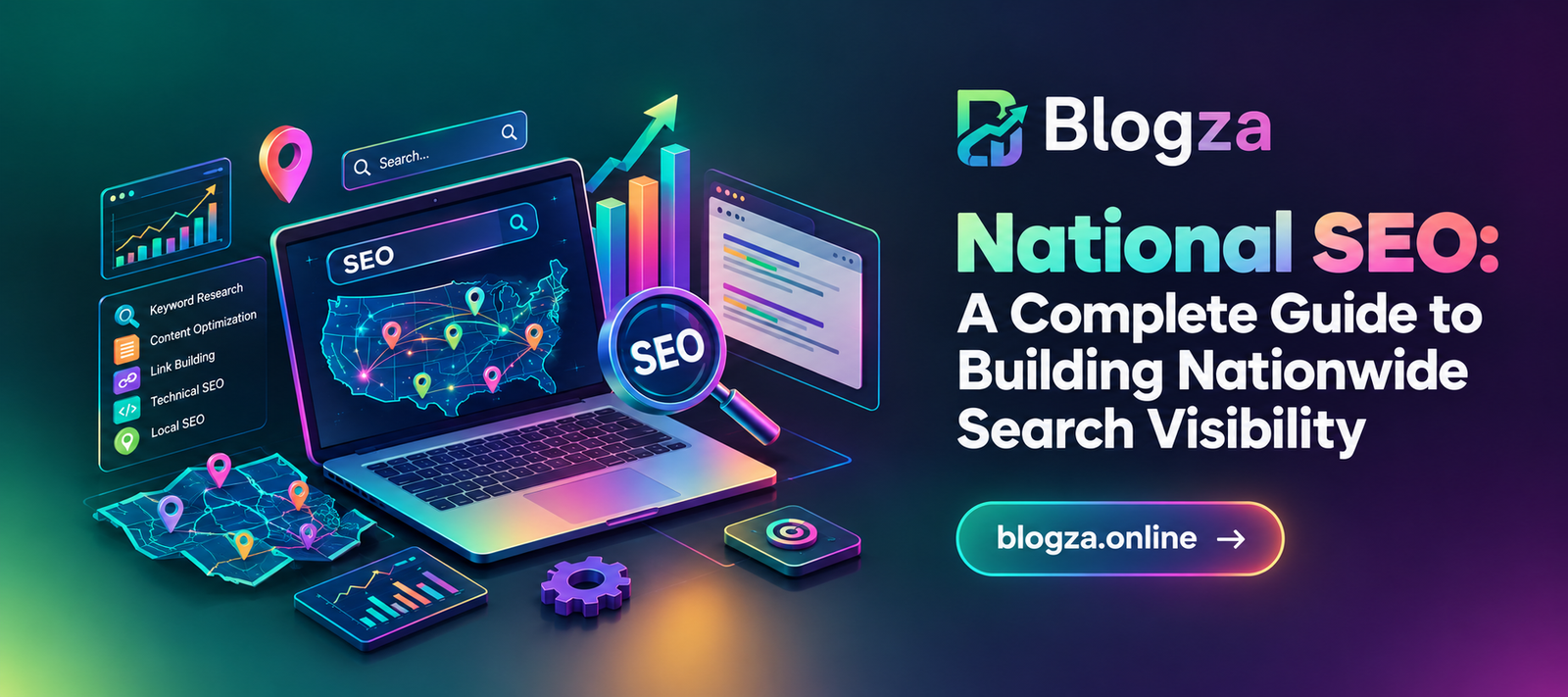
Learn how national SEO works, from keyword research and technical SEO to content, AI Search, AEO, GEO, and nationwide visibility
Table of Contents
What Is National SEO?
National SEO is a search engine optimization approach designed to improve a website’s visibility for searches made across a large geographic market, usually a country rather than a single local area.
For example, an online software company selling its product throughout the United States may optimize for searches such as “project management software,” “best project management tools,” and “project management software for small business.” It does not need to create a separate page for every city because its product is available nationally.
The same principle applies to ecommerce stores, SaaS companies, publishers, online education platforms, national service providers, and businesses with locations or customers across multiple regions.
National SEO typically focuses on:
- Broad and high-intent keywords
- Commercial and informational search queries
- Topic clusters and semantic relevance
- Technical SEO and crawlability
- High-quality content
- Internal linking
- Digital PR and authoritative backlinks
- Strong website architecture
- Conversion-focused landing pages
- Search visibility across different stages of the customer journey
Google’s SEO documentation describes SEO as helping search engines understand content and helping users discover a website through search.
Why National SEO Matters
A business with a nationwide audience can lose valuable organic opportunities if its SEO strategy is limited to local searches. National search visibility allows a brand to reach users who may not yet know the company but are actively researching a product, service, problem, or solution.
For example, someone searching “how to improve website rankings” is not necessarily looking for a business in a particular city. They may be researching the topic before deciding whether to hire an SEO specialist or agency. A well-developed national SEO content strategy can introduce the brand during this research stage.
National SEO can also support the complete marketing funnel. Informational content can attract early-stage visitors, comparison pages can support evaluation, and service or product pages can target users with stronger commercial intent.
However, visibility should not be treated as an automatic business outcome. Ranking for a keyword does not guarantee traffic, leads, sales, or revenue. The SEO strategy needs to connect search demand with useful content and a clear user experience.
National SEO vs Local SEO
The biggest difference between national SEO and local SEO is geographic intent.
Local SEO focuses on searches connected to a specific location, such as:
- “dentist in Hyderabad”
- “SEO agency in Karachi”
- “restaurants near me”
National SEO focuses more heavily on broader queries that are not dependent on one city:
- “SEO services”
- “email marketing software”
- “digital marketing strategy”
- “best accounting software”
- “technical SEO audit”
Local SEO often relies heavily on location signals, Google Business Profile optimization, local citations, reviews, and location-specific pages. National SEO generally places more emphasis on topical authority, broad keyword targeting, content depth, site architecture, and authority signals.
The two approaches can overlap. A national company with physical branches may need both national and local SEO, using different pages and strategies for different search intents.
How National SEO Works
National SEO works through multiple interconnected areas rather than one optimization technique. The objective is to make a website technically accessible, topically relevant, useful to users, and understandable to search engines.
Keyword Research Based on Search Intent
Keyword research is the foundation of a national SEO campaign. Instead of selecting keywords only because they have high search volume, analyze what users are actually trying to accomplish.
Search intent can generally be grouped into informational, commercial investigation, transactional, and navigational behavior.
For example, someone searching “what is technical SEO” has a different intent from someone searching “technical SEO services.” The first query suggests learning intent, while the second may indicate that the user is evaluating a service.
A useful national keyword strategy can therefore include:
- Primary keywords
- Long-tail keywords
- Related questions
- Commercial keywords
- Comparison keywords
- Problem-based searches
- Industry-specific terms
- Entity-related terminology
Google’s systems can understand relationships between words and concepts, so content does not need to repeat an exact keyword unnaturally to be relevant.
Build Topic Clusters
A national website benefits from developing depth around important subjects rather than publishing disconnected articles.
For example, a website focused on digital marketing might create a central topic around SEO and support it with related content covering:
- Keyword research
- On-page SEO
- Technical SEO
- Link building
- SEO content writing
- Local SEO
- National SEO
- Ecommerce SEO
- SEO audits
- Search Console
- SEO reporting
These pages can be connected through contextual internal links. This helps users move naturally between related topics and helps search engines discover and understand the site’s content structure.
The goal should not be to publish dozens of pages simply because keywords exist. Google specifically warns against producing large amounts of low-value content primarily to manipulate search rankings.
Strengthen Technical SEO
Technical SEO provides the foundation on which the rest of a national SEO campaign operates.
Important areas include:
- Crawlability
- Indexability
- XML sitemaps
- Robots.txt configuration
- Canonical URLs
- HTTPS
- Mobile usability
- Page performance
- Internal linking
- Redirects
- Broken links
- Structured data
- URL structure
A technically strong website makes it easier for search engines to discover, crawl, and understand important pages.
Technical SEO is particularly important for large websites because ecommerce stores, publishers, SaaS platforms, and national businesses can have thousands of URLs. Poor architecture or unnecessary indexable pages can make the site harder to manage and can dilute the focus of the website.
Google’s Search Essentials identify technical requirements, spam policies, and key best practices that form the foundation for search visibility.
Create People-First Content
Content remains an important part of national SEO, but the objective should be usefulness rather than word count.
A strong article should answer the user’s question clearly, explain important concepts accurately, provide practical examples, and avoid unnecessary repetition.
For example, an article targeting “technical SEO audit” should not simply define the term. It can explain what an audit checks, how to identify crawl issues, what indexability problems look like, how to review internal links, and what to prioritize after the audit.
Google explicitly states that there is no preferred word count that creators should target. Content should be as comprehensive as necessary to satisfy the reader rather than being expanded simply to reach a particular number.
Develop a Strong Internal Linking Strategy
Internal links connect related pages on the same website. They are useful for both navigation and search discovery.
For example, an article about national SEO could naturally link to a detailed guide about technical SEO services when discussing technical optimization. Another section discussing customer acquisition could link to relevant content about digital marketing strategy.
Good internal links should be:
- Contextually relevant
- Helpful to the reader
- Descriptive
- Naturally placed
- Connected to related content
Avoid adding links simply to increase the number of internal links on a page. Relevance should come first.
Build Authority With Valuable External References
National SEO often involves competing against established websites, which means content quality alone may not always be enough to build visibility.
Businesses can strengthen their online presence through legitimate authority-building activities such as:
- Original research
- Expert commentary
- Digital PR
- Industry publications
- Useful resources
- Data-driven content
- Partnerships
- Genuine editorial mentions
The focus should be on earning recognition because the content or business is genuinely useful, rather than purchasing or creating manipulative links.
Google’s Search Essentials emphasize creating helpful content and making the website discoverable, while its spam policies prohibit tactics designed to manipulate search systems.
National SEO for Different Business Models
National SEO does not look exactly the same for every business.
Ecommerce Businesses
Ecommerce websites can target product categories, product types, comparisons, buying guides, and informational searches. Strong category pages, useful product descriptions, logical navigation, and structured data can all support organic search visibility.
SaaS Companies
Software companies can build content around problems their products solve. For example, a project management platform could create resources about project planning, team collaboration, workflow management, and productivity.
National Service Businesses
Businesses offering services across multiple regions can create service-focused content while maintaining accurate geographic information. However, location pages should have genuine value rather than being nearly identical pages created only to capture city-based keywords.
Publishers and Educational Websites
These websites often have opportunities to build topical authority through comprehensive guides, original explanations, expert contributions, and well-organized content hubs.
National SEO, AI Search, AEO and GEO
Search is becoming increasingly conversational, with users asking longer questions and interacting with generative AI features. This makes it useful to structure content so that important answers are clear and easy to understand.
AEO, or Answer Engine Optimization, generally focuses on making content useful for systems that provide direct answers to questions.
GEO, often used to describe Generative Engine Optimization, focuses on improving the likelihood that information is understood and potentially referenced within generative search experiences.
These concepts should not be treated as separate “ranking hacks.” Google’s current guidance for generative AI search emphasizes the same fundamental approach: create useful, unique, people-first content and follow Search Essentials. Google also warns against creating large numbers of pages for individual query variations primarily to manipulate AI responses or rankings.
For national SEO, practical AI-search optimization can include:
- Answering important questions directly
- Using clear headings
- Explaining concepts with context
- Providing original insights
- Supporting claims with reliable sources
- Using descriptive page structures
- Keeping important information easy to find
- Adding relevant images and other useful media
Google’s AI optimization guidance specifically recommends focusing on what users want instead of creating separate pages for every possible query variation.
Tools for National SEO
A national SEO campaign can use several categories of tools.
Google Search Console helps website owners monitor search performance, indexing, queries, and technical issues.
Google Analytics can help analyze website traffic and user behavior when configured appropriately.
Keyword research tools can help identify search demand, keyword variations, competitors, and content opportunities.
Technical SEO crawlers can identify broken links, redirects, duplicate content, metadata problems, and other technical issues.
Content optimization tools can help with content organization, readability, terminology, and competitive research, but human judgment is still necessary.
The most useful toolset depends on the website’s size, business model, budget, and SEO objectives. Tools provide data; they do not replace strategy.
Common National SEO Mistakes
Targeting Only High-Volume Keywords
High search volume does not automatically mean high business value. A lower-volume keyword with strong commercial intent can be more relevant than a broad term that attracts visitors who are unlikely to become customers.
Publishing Content Without a Clear Purpose
Publishing many articles without understanding the audience can create a large website without building meaningful topical depth. Google advises creators to focus on content that provides substantial value to users rather than producing content primarily for search traffic.
Creating Duplicate Location Pages
A national business may be tempted to create hundreds of city pages with nearly identical text. If those pages offer little unique value, they can create a poor user experience and may fall under Google’s concerns about scaled, low-value content.
Ignoring Technical SEO
Excellent content cannot compensate for serious crawling, indexing, or site-architecture problems. Technical SEO should therefore be reviewed regularly, particularly when a website grows.
Using AI to Produce Content at Scale Without Review
AI can assist with research, brainstorming, outlining, or editing. However, generating large quantities of unoriginal pages without adding value can create SEO and quality problems. Google’s current guidance makes clear that the issue is not simply whether AI was used; the concern is content created primarily to manipulate search rankings or content that provides insufficient value.
Latest National SEO Trends
One important trend is the continued growth of AI-assisted search experiences. Search engines are increasingly capable of understanding context, entities, relationships, and conversational queries. This makes semantic relevance and genuinely useful content more important than mechanical keyword repetition.
Another important development is Google’s continued emphasis on people-first content. The latest Search Central guidance encourages creators to focus on who created the content, how it was created, and why it exists. Trust is a particularly important part of Google’s E-E-A-T framework, although E-E-A-T itself is not a single ranking factor.
Google also updated its documentation in 2026 to clarify AI-search guidance and removed documentation for the FAQ rich-result feature after that feature stopped appearing in Google Search results for general sites. Therefore, publishers should not build their SEO strategy around obtaining FAQ rich results.
How to Measure National SEO Performance
National SEO should be measured using several indicators rather than one ranking position.
Useful measurements include:
- Organic clicks
- Organic impressions
- Search queries
- Click-through rate
- Indexed pages
- Conversions
- Leads or sales
- Organic revenue
- Landing-page performance
- Engagement and user behavior
- Growth in relevant non-branded searches
Google Search Console can provide valuable search-performance data, while analytics platforms can help connect organic visits with actions on the website.
It is also important to evaluate performance over an appropriate period. SEO changes do not always produce immediate results, and individual keyword positions can fluctuate. A broader trend across relevant pages and queries provides a more useful picture of organic performance.
FAQs About National SEO
What is national SEO?
National SEO is the process of optimizing a website to gain organic visibility for relevant searches across a broad geographic market, usually an entire country. It focuses on broad search intent, content quality, technical SEO, authority, and website structure rather than primarily targeting one local area.
What is the difference between national SEO and local SEO?
Local SEO targets searches connected to a particular location, such as a city or neighborhood. National SEO targets broader searches across a country. A business can use both when it has nationwide customers as well as physical locations.
Who needs national SEO?
National SEO can be useful for ecommerce businesses, SaaS companies, online publishers, education platforms, national service providers, and other businesses that serve customers across a large geographic market.
How long does national SEO take?
There is no universal timeline. Results depend on factors such as website history, competition, technical condition, content quality, authority, search demand, and the resources invested in SEO. SEO should be treated as an ongoing process rather than a guaranteed short-term campaign.
Is keyword research important for national SEO?
Yes. Keyword research helps identify how people search for products, services, problems, and information. However, modern SEO should consider search intent and related concepts rather than focusing only on exact-match keywords.
Does AI-generated content hurt SEO?
Using AI does not automatically make content unsuitable for Google Search. The important issue is whether the content provides real value and follows Google’s Search Essentials and spam policies. Google specifically warns against using generative AI to produce large amounts of low-value content primarily to manipulate search rankings.
Can national SEO help with AI Search?
A strong SEO foundation can support visibility across modern search experiences because AI systems need useful, accessible, relevant information to understand websites. Google recommends focusing on helpful content, clear information, relevant media, and established SEO best practices rather than using special AI-ranking shortcuts.
Is national SEO only about ranking on Google?
Google is a major search engine, but a broader digital marketing strategy can also include Bing, social platforms, referral traffic, email marketing, online communities, and other discovery channels. National SEO should therefore work as part of a wider digital strategy rather than operating in isolation.
Conclusion
National SEO is a long-term approach to building organic visibility across a broad geographic market. The strongest strategies combine keyword research, search intent, technical SEO, useful content, internal linking, authority building, and a website structure that makes information easy to discover.
The role of SEO is also expanding as search becomes more conversational and AI-assisted. Rather than chasing every new algorithm change or looking for shortcuts, businesses can build a stronger foundation by understanding their audience, answering real questions, demonstrating expertise, and creating content that users would find valuable even without search engines.
For a national SEO campaign, the practical starting point is simple: understand the audience, identify valuable search topics, fix technical barriers, create genuinely useful resources, connect related pages, measure meaningful outcomes, and improve the website continuously. That approach supports traditional Google Search while also preparing a website for evolving search experiences such as AI Overviews and AI Mode.