
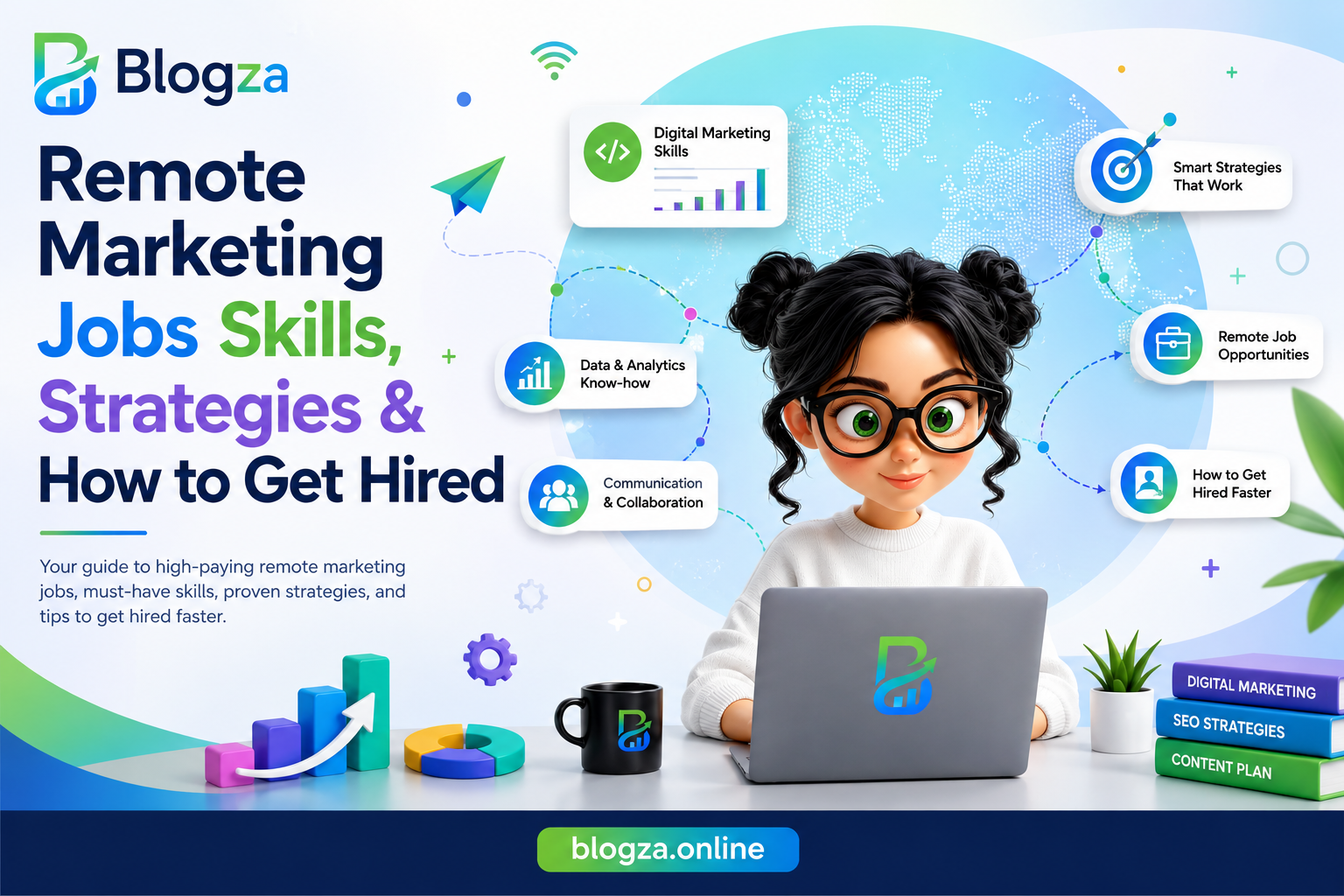
What Are Remote Marketing Jobs?
Remote marketing jobs are marketing positions that can be performed primarily outside a traditional office. Depending on the employer, the role may be fully remote, remote-first, or location-flexible.
Marketing is particularly suitable for remote work because many core activities are digital. Research, content creation, SEO, analytics, email marketing, social media management, paid advertising, design coordination, and campaign reporting can all be handled through online platforms.
Common remote marketing positions include:
- SEO specialist
- Digital marketing specialist
- Content marketer
- Content writer
- Social media manager
- Email marketing specialist
- PPC specialist
- Marketing coordinator
- Marketing analyst
- Affiliate marketing specialist
- Marketing automation specialist
- Growth marketer
- Local SEO specialist
- Technical SEO specialist
The important point is that remote marketing is not one career. It is a broad collection of specialties requiring different combinations of creative, analytical, technical, and communication skills.
Why Remote Marketing Careers Are Attractive
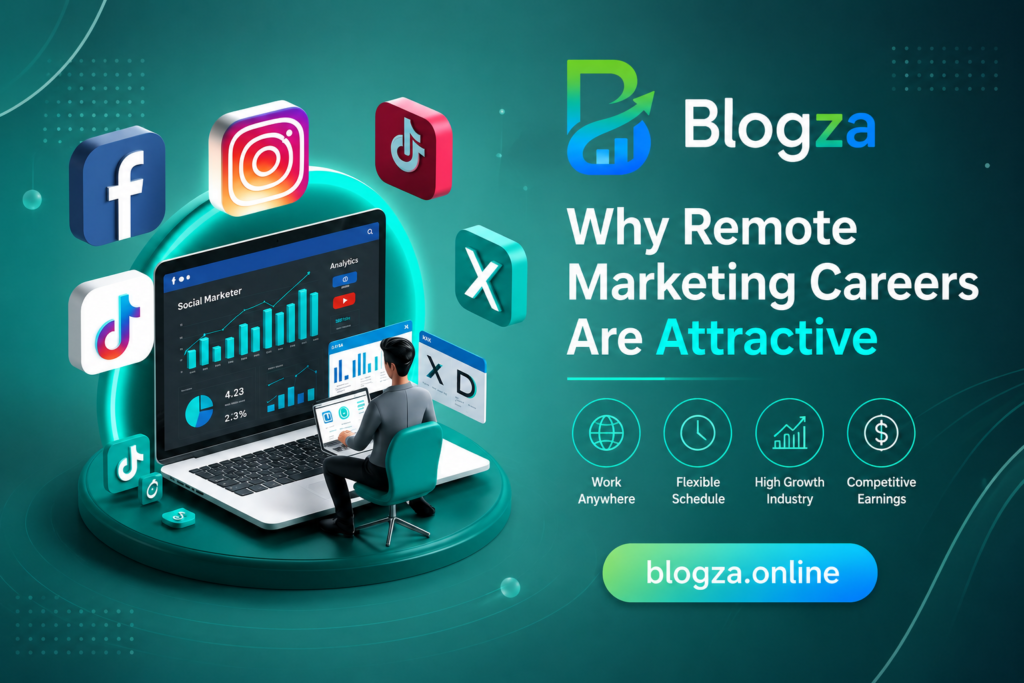
Remote marketing work can provide flexibility while allowing professionals to work with companies outside their immediate geographic area.
For employers, digital marketing work can also be organized through project-management systems, analytics platforms, communication tools, content-management systems, and cloud-based collaboration software.
However, working remotely does not mean working without structure.
Successful remote marketers need to communicate clearly, meet deadlines, document their work, manage projects independently, and understand how their activities contribute to business objectives.
For example, an SEO specialist should not only report that organic traffic increased. A stronger professional can explain:
- Which pages improved
- Which search queries contributed
- What optimization was performed
- Whether conversions changed
- What should happen next
That business-focused approach makes a marketer more valuable than someone who simply knows individual tools.
Types of Remote Marketing Jobs
Remote SEO Jobs
SEO professionals help websites become more visible in search engines and attract relevant organic traffic.
A remote SEO specialist may work on:
- Keyword research
- Search intent analysis
- On-page SEO
- Technical SEO
- Internal linking
- Content optimization
- Competitor research
- Search Console analysis
- SEO reporting
- Local SEO
- Digital PR and link acquisition
SEO is increasingly connected with broader search experiences. Google states that SEO remains relevant to its generative AI search features, while emphasizing unique, valuable content and established SEO fundamentals.
Remote Content Marketing Jobs
Content marketers create and manage useful resources that attract, educate, and convert audiences.
Typical responsibilities include:
- Blog strategy
- Content briefs
- Articles
- Case studies
- Landing pages
- Email content
- Content calendars
- Content distribution
- Performance analysis
Strong content marketers understand that publishing more content is not automatically better. The objective is to answer meaningful audience questions with original, useful information.
Google’s current guidance emphasizes people-first content that provides substantial value rather than content created primarily to manipulate rankings.
Remote Social Media Marketing Jobs
Social media marketers manage a brand’s presence across platforms such as LinkedIn, Instagram, Facebook, TikTok, and other relevant channels.
Their work can include:
- Content planning
- Caption writing
- Community management
- Short-form video strategy
- Social analytics
- Campaign management
- Influencer coordination
- Brand communication
Modern social media marketing requires more than posting regularly. Professionals need to understand audience behavior, platform-specific formats, brand positioning, and measurable business outcomes.
Remote Email Marketing Jobs
Email marketers develop campaigns that nurture leads, retain customers, and encourage conversions.
Common responsibilities include:
- Newsletter creation
- Email sequences
- Audience segmentation
- A/B testing
- Marketing automation
- Lead nurturing
- Performance reporting
A good email marketer understands that a large subscriber list is not enough. Relevance, timing, message quality, segmentation, and conversion goals matter.
Remote PPC and Paid Advertising Jobs
Paid media specialists manage advertising campaigns across platforms such as Google Ads and social advertising networks.
They may work with:
- Search campaigns
- Display advertising
- Shopping campaigns
- Remarketing
- Social advertising
- Conversion tracking
- Budget management
- Landing-page testing
Because paid advertising involves spending real money, employers often value analytical thinking and careful reporting.
Skills You Need for Remote Marketing Jobs
The best skill set depends on the position, but several capabilities are useful across digital marketing careers.
SEO and Search Skills
Understanding search intent, keyword research, on-page optimization, internal linking, technical SEO, and analytics can open opportunities in multiple marketing roles.
Google’s Search Essentials recommends creating helpful, reliable, people-first content and using words that searchers would naturally use in prominent and descriptive areas of a page.
Content and Communication
Remote marketers communicate through written messages, briefs, reports, presentations, emails, and project-management systems.
Clear writing is therefore a professional advantage.
Analytics
You should be comfortable interpreting marketing performance rather than simply collecting numbers.
Useful skills include:
- Google Analytics
- Google Search Console
- Conversion analysis
- Traffic analysis
- Engagement metrics
- Campaign reporting
- Basic spreadsheet analysis
AI Skills
AI has become an important productivity tool for marketers.
A marketer may use AI to:
- Brainstorm content ideas
- Organize research
- Generate content outlines
- Analyze large amounts of information
- Create first drafts
- Improve workflows
- Develop variations for testing
However, AI should support expertise rather than replace it.
Google’s guidance says AI-assisted content can perform well when it is high-quality, original, useful, and aligned with its search policies; using automation primarily to manipulate rankings is not the goal.
Communication and Project Management
Remote teams depend heavily on asynchronous communication.
Learn how to:
- Write concise updates
- Document decisions
- Organize tasks
- Meet deadlines
- Ask useful questions
- Report problems early
- Present results clearly
These skills can make a major difference even when your technical marketing knowledge is strong.
How SEO, AI Search, AEO and GEO Are Changing Marketing
Search is no longer limited to the traditional list of blue links.
Users increasingly interact with search through AI-powered experiences, conversational interfaces, and more complex queries.
This creates opportunities for marketers who understand SEO, AEO, and GEO together.
SEO
Search Engine Optimization focuses on improving a website’s ability to be discovered and understood through search engines.
AEO
Answer Engine Optimization focuses on making information clear and useful for systems that provide direct answers.
For example, instead of writing a vague paragraph about SEO, an AEO-friendly article might directly answer:
What is technical SEO?
Then explain the concept clearly in a concise section before providing deeper information.
GEO
Generative Engine Optimization refers to strategies intended to improve the likelihood that content is useful and discoverable within generative AI search experiences.
Importantly, Google’s 2026 guidance says there is no need to abandon traditional SEO for generative AI search. Instead, SEO fundamentals remain foundational, alongside creating unique, valuable content and considering useful text, images, and video.
This means future marketers should learn how to create content that works for humans, traditional search engines, and AI-powered discovery systems.
How to Find Legitimate Remote Marketing Jobs
Finding a remote position requires more than searching for one keyword.
Start by identifying your specialization.
For example, search for combinations such as:
- Remote SEO specialist
- Remote digital marketing specialist
- Remote content marketing jobs
- Remote social media manager
- Remote SEO content writer
- Remote PPC specialist
- Remote marketing coordinator
- Entry-level remote marketing jobs
- Remote marketing jobs for beginners
Then evaluate each job description carefully.
Look for information about:
- Employment type
- Location restrictions
- Required experience
- Working hours
- Responsibilities
- Compensation structure
- Interview process
- Company information
Be cautious with opportunities that demand money upfront, promise unrealistic earnings, request sensitive information too early, or provide vague job descriptions.
A legitimate remote marketing job should still have understandable responsibilities and a reasonably verifiable employer.
Build a Portfolio Before Applying
A portfolio can be especially useful when you do not yet have extensive professional experience.
You can demonstrate skills through practical projects.
For example, an SEO portfolio could include:
- A keyword research example
- An on-page SEO audit
- A technical SEO checklist
- A content brief
- A before-and-after optimization example
- A sample Search Console report
- An internal linking strategy
A content marketer could demonstrate:
- Blog articles
- Content calendars
- Landing-page copy
- Email sequences
- Social media campaigns
The key is to explain what you did and why.
Instead of simply saying:
“I know SEO.”
Show:
“I analyzed search intent, grouped related keywords, created a content structure, optimized headings and internal links, and developed a measurement plan.”
That provides evidence of practical thinking.
Tools Remote Marketers Should Learn
You do not need to master every marketing platform. Start with tools relevant to your chosen specialty.
Useful categories include:
SEO Tools
- Google Search Console
- Google Analytics
- Google Trends
- Ahrefs
- Semrush
- Screaming Frog
Content Tools
- WordPress
- Google Docs
- Canva
- Content-management systems
- AI writing and research assistants
Marketing and Collaboration Tools
- Slack
- Microsoft Teams
- Trello
- Asana
- Notion
- Project-management platforms
The tool itself is less important than understanding what problem it solves.
For example, knowing where a button is in an SEO tool is less valuable than understanding how to interpret keyword intent, technical issues, content gaps, and search performance.
Practical Strategy for Getting Your First Remote Marketing Role
Choose One Primary Skill
Avoid presenting yourself as an expert in everything.
Choose one main area such as SEO, content marketing, social media, email marketing, or paid advertising.
Then develop supporting skills.
For example:
SEO specialist
Primary skill: SEO
Supporting skills: content, analytics, WordPress, keyword research, AI-assisted workflows
Create Demonstration Projects
Build two or three realistic projects that show your ability.
They can be personal projects, sample campaigns, or work created specifically for your portfolio, provided you clearly identify them as such.
Optimize Your Resume and LinkedIn Profile
Use language that matches the roles you are targeting.
Instead of writing:
“Worked on websites.”
Use specific descriptions such as:
“Performed keyword research, optimized on-page elements, improved internal linking, and created SEO-focused content briefs.”
Apply With Relevance
Sending the same application to every company is usually less effective than tailoring your application to the role.
Study the job description and identify the skills the employer actually needs.
Then make your resume and portfolio demonstrate those skills.
Common Mistakes When Looking for Remote Marketing Jobs
Applying Without a Specialization
“Digital marketer” can describe many different responsibilities. Employers may respond more strongly when your profile clearly communicates what you do best.
Having Skills but No Evidence
Listing SEO, AI, analytics, WordPress, and social media on a resume is less persuasive without examples.
Create projects that demonstrate those abilities.
Ignoring Communication
A technically skilled remote employee can still struggle if they cannot communicate deadlines, blockers, progress, or results.
Using AI Without Human Review
AI-generated material can contain inaccuracies, repetitive language, weak reasoning, or unsupported claims.
Use AI as an assistant, then verify facts, add expertise, improve originality, and review the final work.
Chasing Every Marketing Trend
Not every new platform or technique deserves your attention.
Build strong fundamentals first. SEO, content quality, analytics, audience research, conversion principles, and communication remain valuable even as tools change.
Latest Google Search Developments Marketers Should Know
Google’s search documentation continues to evolve as search becomes more complex.
In July 2026, Google Search Central documented new guidance around analyzing social and video platform content performance in Search Console. It also introduced updates concerning review snippets and other Search documentation.
Another important development is Google’s dedicated 2026 guidance for optimizing websites for generative AI features. The guidance emphasizes valuable, unique content and explains that traditional SEO practices remain important for generative AI search.
For marketers, the practical lesson is simple: do not build your career around one algorithm trick.
Build skills that remain useful across changing search systems.
Future Trends in Remote Marketing
AI-Assisted Marketing
AI will continue changing how marketers research, draft, analyze, personalize, and automate work.
The valuable professional will increasingly be the person who knows how to use AI effectively while applying human judgment.
Search Beyond Traditional Results
Marketers should understand how people discover information through search engines, AI interfaces, social platforms, videos, communities, and other digital environments.
Stronger Demand for Original Expertise
As automated content becomes easier to produce, genuinely useful experience and original analysis can become more important differentiators.
Google’s people-first guidance specifically encourages original information, substantial value, expertise, and clear authorship where appropriate.
Marketing and Data Integration
Future marketers will increasingly need to connect content and campaigns with measurable outcomes.
Understanding traffic is useful. Understanding how traffic contributes to leads, sales, retention, or other business objectives is much more powerful.
FAQs About Remote Marketing Jobs
What are the best remote marketing jobs for beginners?
SEO content writing, social media assistance, marketing coordination, email marketing assistance, and junior digital marketing roles can be accessible starting points. Your chances improve when you have practical projects demonstrating relevant skills.
Can I get a remote marketing job without experience?
Yes. Entry-level opportunities exist, but employers still want evidence that you can perform the work. Build a portfolio with practical projects, certifications where useful, and clearly documented examples of your skills.
What skills are most important for remote marketing jobs?
Important skills include communication, content creation, SEO, analytics, audience research, social media, AI literacy, and project management. The ideal combination depends on the specific marketing role.
Is SEO still useful for remote marketing careers?
Yes. SEO remains a core digital marketing discipline, and Google’s current guidance says established SEO practices remain foundational even as generative AI features become part of Search.
Should marketers learn AI?
Yes. AI literacy can improve research, productivity, analysis, ideation, and workflow automation. However, marketers should verify outputs and add human expertise rather than relying blindly on generated material.
What is AEO in digital marketing?
AEO, or Answer Engine Optimization, focuses on structuring and presenting information so it can provide clear answers to users and answer-oriented search experiences. It works best alongside strong SEO and useful, well-organized content.
What is GEO in marketing?
GEO generally refers to Generative Engine Optimization: improving the usefulness and discoverability of content within generative AI search experiences. Google’s current guidance emphasizes valuable, unique content rather than manipulative tactics.
How can I stand out when applying for remote marketing jobs?
Choose a clear specialization, build a practical portfolio, demonstrate measurable thinking, tailor applications to each role, communicate professionally, and show that you understand modern SEO, AI, analytics, and marketing fundamentals.
Internal Linking Opportunities
For a website covering digital marketing and SEO, consider linking this article to:
- Digital Marketing Services: A Complete Guide to Growing Your Business Online
- What Is Business Finance? A Beginner’s Guide
- Affordable SEO Services: What Businesses Should Look For
- Best Digital Asset Management Platform for Enterprise Marketing
- Digital Marketing Jobs: Skills, Roles and Career Opportunities
Conclusion
Remote marketing jobs offer opportunities across SEO, content marketing, social media, email, paid advertising, analytics, and emerging AI-focused search strategies.
But getting hired is not simply about collecting marketing tools or adding dozens of skills to a resume. The stronger approach is to choose a specialization, build practical evidence, understand how marketing contributes to business goals, and continuously improve your digital skills.
SEO remains important, but modern marketers should think beyond traditional rankings. AI search, AEO, GEO, content quality, analytics, technical knowledge, and communication are becoming increasingly relevant to the way digital marketing work is performed.
If you want to start a remote marketing career, begin with one marketable skill, create real projects, document your process, build a professional portfolio, and apply consistently to relevant opportunities.
The goal is not to look like someone who knows every marketing trend. The goal is to become someone who can solve real marketing problems remotely and clearly demonstrate the value of that work.