
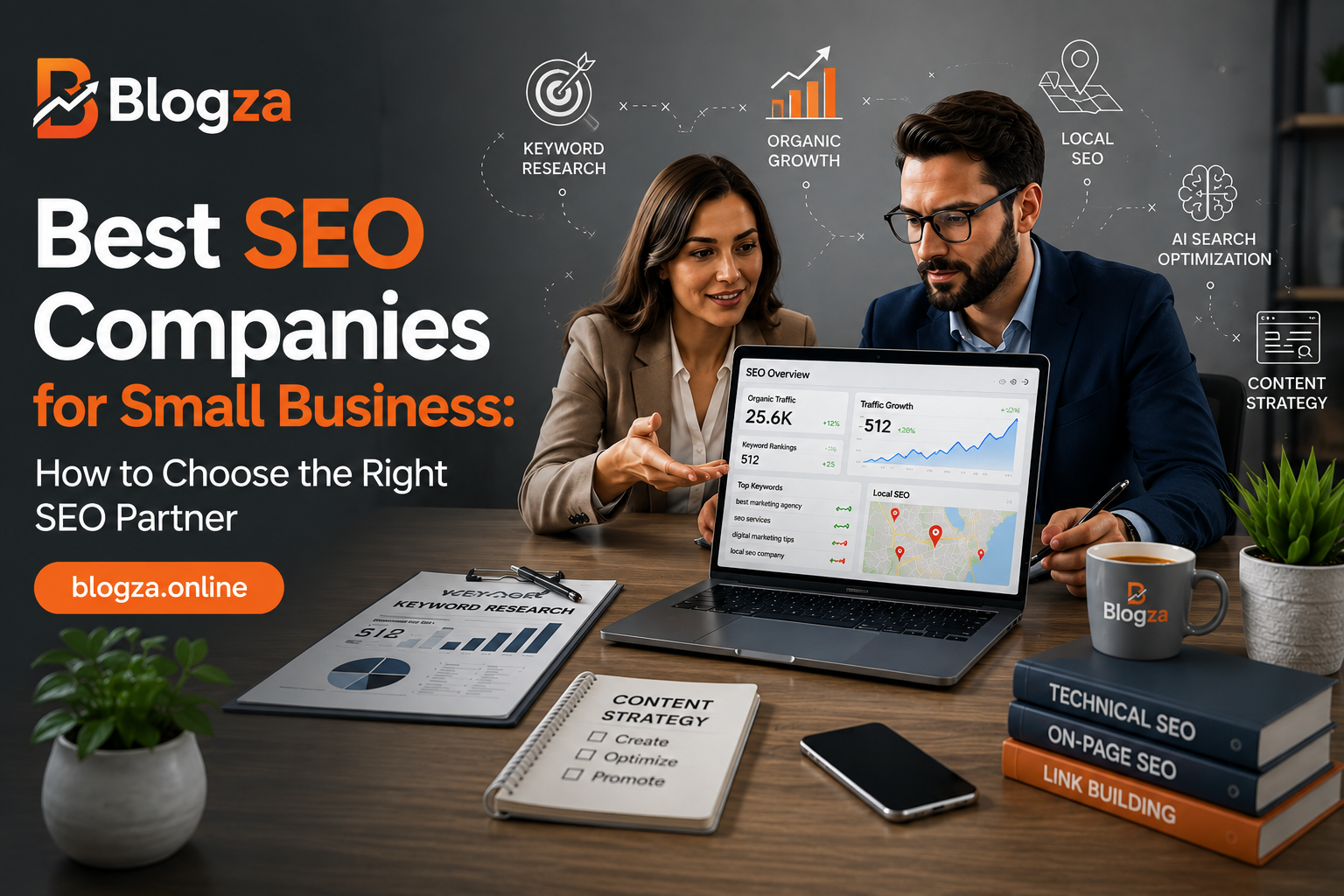
Best SEO Companies
Compare the best SEO companies for small business, services, pricing, local SEO, AI search, and tips for choosing the right agency.
Table of Contents
Why SEO Matters for Small Businesses
Small businesses often compete against companies with larger advertising budgets and more established brands. SEO can provide another way to reach customers who are actively searching for information, products, or services.
Organic search is particularly useful when your audience repeatedly searches for the problems your business solves. Instead of paying for every individual advertising click, an optimized page can continue attracting relevant visitors after it has been created and improved.
SEO can help a small business:
- Increase relevant organic visibility
- Reach customers during research and buying stages
- Generate local discovery through Google Search and Maps
- Build topical authority through useful content
- Improve website usability and structure
- Support ecommerce product discovery
- Reduce dependence on a single marketing channel
- Create assets that can support long-term digital marketing
However, SEO should not be treated as a guaranteed shortcut to page-one rankings. Search visibility depends on many factors, including competition, relevance, website quality, technical accessibility, content, authority, location, and search context.
Google’s Search Essentials describe technical requirements, spam policies, and key best practices that site owners should consider when appearing in Search.
How the Best SEO Companies for Small Business Work
A professional SEO campaign usually begins with research rather than immediate content production.
The agency should first understand the business model, target customers, competitors, existing website, geographic market, products or services, and commercial priorities. From there, it can identify opportunities and create a prioritized strategy.
SEO Audit and Website Analysis
An SEO audit examines how well a website can be crawled, understood, indexed, and used by visitors.
A useful audit can review:
- Website architecture
- Indexation
- Internal links
- Page titles and headings
- Meta descriptions
- Duplicate or thin content
- Broken links
- Mobile usability
- Page performance
- Redirects
- Canonicalization
- Structured data
- Image optimization
- Security and accessibility issues
The goal isn’t to create a giant technical checklist for its own sake. The agency should explain which problems actually matter and which should be addressed first.
Keyword Research
Keyword research identifies the language potential customers use when looking for information, products, or services.
For a small business, this should go beyond chasing high-volume keywords.
For example, a local plumbing company might target broad terms such as “plumber,” but more commercially useful searches could include:
- emergency plumber near me
- water heater repair in [city]
- residential plumbing services
- bathroom plumbing repair
- leaking pipe repair
The best keyword strategy connects search intent with business value.
Informational searches can attract people researching a problem, while commercial and transactional searches may bring people closer to contacting a business or purchasing something.
Google’s SEO guidance also recommends anticipating different ways people may search for the same information rather than obsessing over one exact keyword phrase.
On-Page and Content SEO
Once search opportunities are identified, the agency can improve existing pages and create new ones.
Strong content should answer the user’s actual question clearly and demonstrate useful knowledge. Depending on the business, this may include service pages, product pages, buying guides, comparison articles, FAQs, tutorials, case examples, and local resources.
A small business should avoid publishing dozens of generic AI-generated articles simply because they contain target keywords. Google specifically warns against scaled content created primarily to manipulate search rankings, including large quantities of low-value content generated with AI or other methods.
AI can assist with research, organization, editing, or ideation, but human expertise and meaningful value should remain central.
Local SEO Is Especially Important for Many Small Businesses
If customers visit your location or search for services within a particular area, local SEO deserves special attention.
Local SEO can involve:
- Google Business Profile optimization
- Accurate business information
- Local service pages
- Location-specific content
- Review management
- Relevant local links and citations
- Local structured data
- Consistent business information
- Conversion-focused contact information
Google says local results are primarily influenced by relevance, distance, and prominence. Businesses cannot simply pay Google to receive better organic local rankings.
This means an agency promising that it can “guarantee the #1 Google Maps position” should immediately raise questions.
A good local SEO company instead explains what it can control: improving the accuracy and relevance of the Business Profile, strengthening the website, creating useful local content, earning legitimate mentions, and improving the customer experience.
AI Search, AEO and GEO for Small Businesses
Search is increasingly becoming more conversational. People may ask longer questions rather than typing a short keyword, and search experiences can provide synthesized answers alongside traditional results.
That makes clear, well-structured information increasingly valuable.
Answer Engine Optimization (AEO) generally focuses on making content useful for direct-answer experiences, while Generative Engine Optimization (GEO) is commonly used to describe efforts to improve a brand’s visibility in AI-generated answers.
These concepts should not be treated as secret ranking systems or guaranteed AI-citation techniques.
A practical strategy is to:
- Answer important customer questions directly
- Explain concepts clearly
- Use descriptive headings
- Support important claims with credible sources
- Demonstrate first-hand expertise where appropriate
- Keep business information accurate
- Build recognizable brand authority
- Create content that genuinely deserves to be referenced
Google’s people-first guidance emphasizes original information, expertise, clear authorship where appropriate, and content that leaves readers satisfied rather than forcing them to search again.
Best SEO Companies for Small Business to Consider
There is no universal “best” SEO agency because the right choice depends on your industry, location, budget, website, and objectives. The following companies are worth researching because they publicly offer small-business or broad SEO services.
SmartSites
SmartSites offers SEO alongside services such as web design, PPC, content, analytics, and other digital marketing services. Its small-business offering specifically includes SEO and local visibility, making it relevant for companies that want several marketing services from one provider.
Its broader SEO offering includes areas such as technical SEO audits, consulting, blogging, SEO copywriting, link building, mobile SEO, and website migration.
Best fit: Small businesses wanting SEO combined with broader digital marketing capabilities.
Straight North
Straight North has a dedicated small-business SEO service focused on lead generation and growth. Its published process covers learning about the business, research, strategy development, execution, and reporting.
The agency also publishes SEO/GEO pricing guidance explaining that campaign costs depend on factors such as competition, website size, geographic targeting, current performance, and business objectives.
Best fit: Small businesses focused strongly on qualified leads and measurable marketing outcomes.
HigherVisibility
HigherVisibility offers broad SEO services, including local SEO, technical SEO, content, link-related work, and AI-focused search services. Its local SEO offering specifically addresses small and multi-location businesses.
Its local SEO service includes areas such as keyword research, local SEO audits, content optimization, internal linking, local schema, and technical remediation.
Best fit: Small businesses that need a structured SEO program, especially local or multi-location businesses.
WebFX
WebFX is another established agency worth evaluating if you need SEO alongside PPC, web development, and broader digital marketing. Its current SEO company overview lists SEO, AI SEO, PPC, and web design and development among its services.
Best fit: Businesses looking for a larger full-service digital marketing provider.
These companies should be viewed as a research shortlist, not a guaranteed ranking of the best agencies. Agency suitability changes according to your needs, budget, industry, location, communication expectations, and the specific team assigned to your account.
How Much Does Small Business SEO Cost?
SEO pricing varies substantially.
A small local business with a relatively simple website may need a different level of investment from an ecommerce company with hundreds of product pages or a national company competing in a highly competitive industry.
For example, HigherVisibility’s 2026 pricing guide places a typical small-business SEO budget in the $1,500–$3,000 per month range, while noting that actual requirements vary by business size and needs.
This should not be treated as an industry-wide fixed price.
Before comparing quotes, ask what the monthly fee actually includes.
A cheaper package might include basic reporting and limited optimization, while a more expensive engagement may include technical implementation, content production, local SEO, link acquisition, strategy, and conversion tracking.
The question should therefore be:
“What business problem will this investment solve, and what work will we receive?”
rather than simply:
“Which agency is cheapest?”
What to Look for When Choosing an SEO Agency
Before signing a contract, evaluate the agency against practical criteria.
Relevant Experience
Look for experience with businesses similar to yours. A company experienced in national ecommerce SEO may not be the ideal choice for a local restaurant, while a local SEO specialist may not have the technical expertise needed for a large Shopify store.
Transparent Reporting
A useful monthly report should help you understand what changed and why.
Look for reporting around:
- Organic traffic
- Search visibility
- Important landing pages
- Conversions or leads
- Keyword trends
- Technical improvements
- Content published
- Links or digital PR activity
- Local search performance where relevant
- Recommended next actions
Clear Communication
You should know who manages your account, how frequently you communicate, and how implementation works.
SEO recommendations are less useful if nobody on the team can explain them in business terms.
Realistic Expectations
Be cautious when an agency guarantees a specific Google ranking, promises immediate organic success, or claims to know secret Google ranking techniques.
Search results are dynamic, and even technically correct SEO work cannot guarantee a particular position.
Ethical SEO Practices
Ask directly about link building, content creation, automation, and AI usage.
Avoid agencies that propose:
- Mass-produced low-value content
- Manipulative link schemes
- Hidden text
- Keyword stuffing
- Fake reviews
- Doorway pages
- Automatically generated pages with little original value
Google’s spam policies specifically identify scaled content abuse as a problem when large quantities of content are produced primarily to manipulate rankings rather than help users.
SEO Tools Small Businesses Can Use
You do not necessarily need an expensive collection of tools.
Useful platforms include:
- Google Search Console for search performance and indexing information
- Google Analytics for website behavior and conversion analysis
- Google Business Profile for local business visibility
- Google Keyword Planner for keyword research
- Semrush for competitive and keyword research
- Ahrefs for backlink, keyword, and competitor analysis
- Screaming Frog SEO Spider for technical crawling
- PageSpeed Insights for performance diagnostics
The tool itself is not the strategy. An experienced SEO professional should be able to turn data into prioritized actions.
Google describes Search Console as a tool that helps website owners and SEO professionals understand how websites perform in Google Search.
Common SEO Mistakes Small Businesses Should Avoid
One common mistake is choosing an agency solely because it promises fast rankings.
Another is focusing entirely on keywords while ignoring conversion. Getting visitors who never call, purchase, book, or submit a form does not necessarily produce business growth.
Other mistakes include publishing thin content, ignoring technical problems, neglecting local SEO, buying low-quality links, failing to track conversions, and changing strategies every few weeks without allowing enough time to evaluate meaningful results.
Small businesses should also avoid expecting SEO to replace every other marketing channel. SEO can work alongside paid search, email marketing, social media, referral marketing, and other digital strategies.
Latest SEO Trends Small Businesses Should Watch
The most useful trend is not a particular “hack.” It is the continued shift toward better information and better search experiences.
Businesses should pay attention to:
AI-assisted search: Customers increasingly interact with search through conversational questions and AI-generated experiences.
First-hand expertise: Generic content is easier to produce than ever, making genuine experience, useful examples, original analysis, and trustworthy information more valuable.
Local search: For location-dependent businesses, accurate Business Profile information and strong local relevance remain essential.
Technical quality: Search engines still need to crawl, render, understand, and index websites effectively.
Conversion-focused SEO: Rankings and traffic should ultimately support business goals.
Responsible AI use: AI can help with research and workflows, but mass-producing low-value pages for search manipulation can create problems. Google’s current spam guidance explicitly addresses scaled content abuse regardless of whether automation, humans, or a combination are involved.
Google also continues to update its Search documentation and recommendations, so businesses should rely on current official guidance instead of outdated SEO myths.
FAQs About the Best SEO Companies for Small Business
What is the best SEO company for a small business?
There is no single best SEO company for every small business. Agencies such as SmartSites, Straight North, HigherVisibility, and WebFX offer different combinations of SEO and digital marketing services. The right choice depends on your goals, industry, location, website, budget, and required level of support.
How much should a small business spend on SEO?
There is no universal amount. A small-business SEO campaign can vary according to competition, website size, geographic targeting, content requirements, technical complexity, and business goals. One current industry pricing guide from HigherVisibility places many small-business campaigns around $1,500–$3,000 per month, but actual proposals can differ considerably.
Is SEO worth it for a small business?
SEO can be valuable when customers actively search for the products, services, or information a business provides. Its value increases when the company has a clear conversion path and can measure leads, sales, bookings, calls, or other meaningful outcomes.
How long does small business SEO take?
SEO does not have a universal timeline. Results depend on competition, website condition, content quality, authority, location, technical issues, and the amount of work being implemented. A reputable agency should explain milestones rather than promise a guaranteed ranking within a specific number of days.
Should a small business hire an SEO agency or freelancer?
Either can work. An experienced freelancer may provide more direct communication and lower overhead, while an agency may provide specialists across technical SEO, content, local SEO, development, analytics, and digital PR. The better choice depends on the complexity of your campaign and the skills you need.
Does local SEO matter for small businesses?
Yes, especially when customers search for businesses or services in specific locations. Google says local search visibility is influenced primarily by relevance, distance, and prominence. Keeping your Business Profile complete and accurate is therefore an important part of local SEO.
Can AI replace an SEO company?
AI can support SEO tasks such as research, outlining, analysis, and content workflows, but it does not remove the need for strategy, business knowledge, technical implementation, editorial judgment, and quality control. Google emphasizes that content should provide real value to people rather than being produced primarily to manipulate Search.
How do I know if an SEO company is legitimate?
Look for transparent services, realistic expectations, clear reporting, relevant experience, ethical practices, and an explanation of how success will be measured. Ask exactly what the agency will do each month and how those activities connect to your business goals.
Conclusion
Choosing among the best SEO companies for small business is less about finding an agency with the biggest marketing claims and more about finding a partner whose strategy matches your business.
Start by defining what you actually need: local visibility, ecommerce SEO, technical improvements, content marketing, lead generation, or a broader digital marketing strategy. Then compare agencies based on relevant experience, communication, reporting, pricing transparency, ethical practices, and measurable business objectives.
A strong SEO partner should be willing to explain what it is doing, why it matters, what can realistically be achieved, and how progress will be evaluated. Most importantly, the strategy should create a better experience for your customers—not simply a page designed to satisfy a search engine.
For a small business, that people-first approach is the foundation of sustainable SEO and a much better starting point than chasing shortcuts or guaranteed rankings.


[…] Monthly SEO services are most valuable when they are treated as an ongoing business growth process rather than a collection of repetitive SEO tasks. […]