
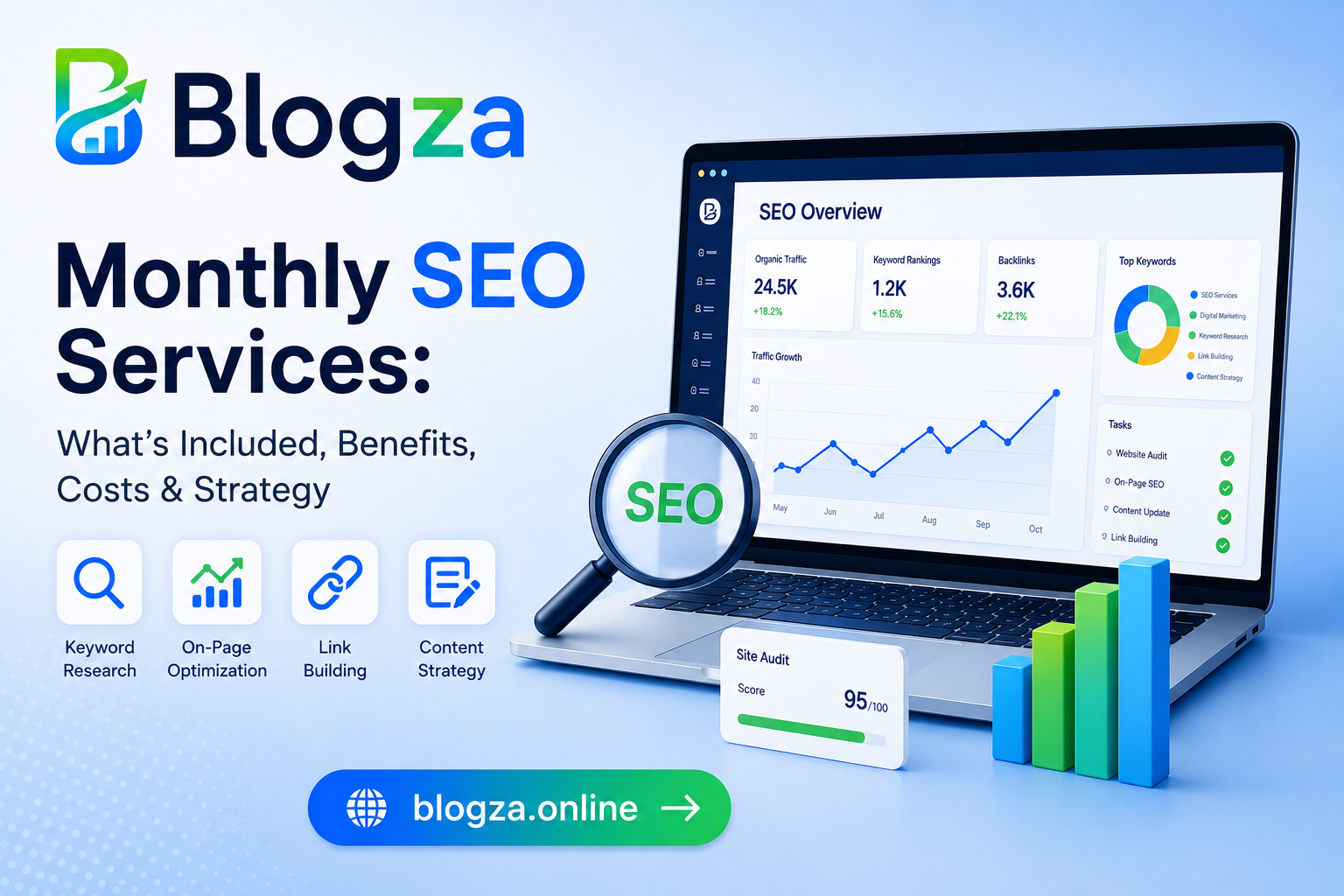
Learn what monthly SEO services include, how they work, what they cost, and how ongoing SEO supports Google Search and AI visibility.
Table of Contents
What Are Monthly SEO Services?
Monthly SEO services are recurring search engine optimization activities performed continuously to improve a website’s organic search performance.
Unlike a one-time SEO audit, monthly SEO involves repeated research, implementation, monitoring, testing, content development, technical improvements, and reporting. A typical monthly SEO campaign may include keyword research, on-page optimization, technical SEO, content strategy, internal linking, local SEO, competitor analysis, performance monitoring, and conversion-focused improvements.
The purpose is not to make random changes every month. A good SEO campaign follows a strategy.
For example, an online education website might begin by fixing technical indexing problems, then build content around high-intent educational keywords, strengthen internal links, improve existing articles, and monitor which topics generate qualified visitors. As performance data becomes available, the strategy can be adjusted.
Google describes SEO as helping search engines understand content while helping users discover a site and decide whether to visit it.
Why Monthly SEO Matters
Search visibility is dynamic. A page that performs well today may face new competitors tomorrow. Search queries can change, customers can adopt new terminology, and previously successful content can become outdated.
Monthly SEO creates a system for responding to these changes.
An ongoing campaign can identify pages losing impressions, discover new keyword opportunities, update outdated information, repair technical problems, strengthen internal linking, and create content around emerging customer questions.
It also gives businesses enough time to evaluate patterns rather than reacting to every short-term ranking movement. SEO performance should be evaluated through a combination of visibility, relevant traffic, engagement, leads, sales, and other business outcomes—not through one keyword position alone.
This long-term approach is particularly important because Google does not guarantee that following SEO best practices will result in crawling, indexing, or specific rankings.
What Is Included in Monthly SEO Services?
The exact package differs between providers, but comprehensive monthly SEO usually combines several areas.
Keyword Research and Search Intent
Keyword research is the foundation of an SEO campaign. The objective is not simply to collect keywords with high search volume. The better question is whether a query represents a valuable opportunity for the business.
An SEO specialist may evaluate:
- Search intent
- Keyword relevance
- Competition
- Commercial value
- Long-tail queries
- Related questions
- Existing rankings
- Content gaps
- Local search opportunities
- Conversion potential
For example, someone searching “what is technical SEO” has a different intent from someone searching “technical SEO services for small business.”
The first query is primarily informational. The second has stronger commercial intent.
Modern keyword research should therefore map keywords to the customer journey rather than creating one page for every keyword variation. Google also notes that its language systems can understand relationships between content and queries even when exact keyword variations are not explicitly included.
Technical SEO
Technical SEO focuses on making a website accessible, understandable, crawlable, and usable for both search engines and visitors.
Monthly technical SEO may involve monitoring:
- Indexing problems
- Crawl errors
- Broken links
- Redirects
- Canonicalization
- XML sitemaps
- Robots.txt
- Mobile usability
- Page experience
- JavaScript-related issues
- Duplicate content
- Site architecture
- Structured data
- HTTPS and security
Technical SEO does not mean making a website unnecessarily complicated. In many cases, the goal is to remove barriers that prevent important content from being properly discovered and understood.
Google recommends checking crawling, indexing, page experience, structured data, and other technical fundamentals as part of maintaining a search-friendly website.
On-Page SEO
On-page SEO improves the content and structure of individual pages.
A monthly SEO team may optimize:
- Page titles
- Meta descriptions
- H1 and heading structure
- Content organization
- Search intent alignment
- Internal links
- Image alt text
- URLs
- Content clarity
- Relevant terminology
- Calls to action
Good on-page SEO should improve the experience for readers first. For example, changing a heading to make it clearer can benefit both users and search engines.
Keyword stuffing is not a sustainable strategy. Instead, the content should naturally cover the topic, answer important questions, demonstrate expertise, and help readers accomplish their goals.
Content Marketing and SEO
Content is one of the most important components of ongoing SEO because search visibility depends heavily on useful information that satisfies real search needs.
A monthly SEO content strategy may include:
- New blog posts
- Service pages
- Product content
- Comparison pages
- Educational guides
- FAQ content
- Content refreshes
- Topic clusters
- Supporting internal links
- Expert-led articles
The strongest content does more than repeat information already available online. Google’s current generative AI guidance specifically emphasizes creating unique, valuable, non-commodity content with useful perspectives and genuine expertise.
For a digital marketing website, for example, a generic article about SEO may have limited differentiation. A stronger article could explain how a small business should prioritize technical SEO, local SEO, content marketing, and conversion tracking based on its actual situation.
AI Search, AEO and GEO
Monthly SEO has increasingly expanded beyond traditional blue-link rankings.
Google now provides AI experiences such as AI Overviews and AI Mode, which can surface links from websites that help support generated responses. Google states that foundational SEO practices remain relevant for these experiences and that there are no special technical requirements specifically for appearing in AI Overviews or AI Mode.
This is where concepts such as AEO (Answer Engine Optimization) and GEO (Generative Engine Optimization) enter the discussion.
These approaches often focus on making information clear, authoritative, well structured, and useful for conversational questions. However, businesses should be careful about claims of secret “AI ranking hacks.” Google’s current guidance specifically warns against unsupported tactics and emphasizes foundational SEO and valuable content instead.
A practical monthly strategy can therefore include:
- Answering specific customer questions
- Creating clear definitions
- Providing original expertise
- Structuring content logically
- Supporting claims with trustworthy sources
- Improving internal linking
- Maintaining crawlable content
- Monitoring visibility in emerging search experiences
Google also introduced generative AI performance reporting in Search Console in 2026, initially rolling it out to a subset of websites to help measure visibility in AI search experiences.
Local SEO
For businesses serving a specific geographic area, local SEO can become an important part of monthly SEO services.
Local SEO activities may include:
- Google Business Profile optimization
- Local keyword research
- Location-specific landing pages
- NAP consistency
- Review strategy
- Local content
- Local link opportunities
- Business information updates
- Local search performance monitoring
For example, a dermatology clinic targeting Hyderabad would not necessarily benefit from focusing only on broad terms such as “dermatologist.” More useful opportunities could involve searches connected to location, services, and user needs.
Local SEO should reflect genuine business information and real customer needs rather than creating large numbers of thin location pages.
How Monthly SEO Services Work
A professional campaign usually begins with an assessment rather than immediately publishing content.
Initial SEO Audit
The first stage identifies the website’s current condition.
An audit may review:
- Organic visibility
- Existing rankings
- Technical health
- Indexed pages
- Content quality
- Internal linking
- Backlinks
- Competitor visibility
- Conversion paths
- Local search presence
The findings become the basis for a prioritized SEO roadmap.
Strategy and Prioritization
Not every SEO issue deserves immediate attention.
A useful approach is to classify tasks according to potential impact, effort, urgency, and business value.
For example, fixing an important indexing problem may take priority over changing minor metadata on dozens of pages.
Monthly Implementation
The SEO team then implements agreed activities. Depending on the campaign, this could involve technical fixes, content updates, keyword targeting, internal linking, digital PR or link acquisition, local SEO, and conversion improvements.
Monitoring and Optimization
Performance data helps determine what should happen next.
An SEO professional might identify a page receiving impressions but few clicks and improve its title or content alignment. Another page might be ranking on the second page for a valuable query, making it a candidate for content improvement and stronger internal links.
This creates an ongoing research → implementation → measurement → refinement cycle.
Benefits of Monthly SEO Services
The biggest advantage of recurring SEO is consistency.
A monthly campaign can help a business:
- Build organic visibility over time
- Maintain technical website health
- Expand relevant keyword coverage
- Improve existing content
- Discover new search opportunities
- Strengthen internal linking
- Develop topical authority
- Improve local search visibility
- Adapt to changes in search behavior
- Measure SEO against business objectives
Another benefit is learning. SEO data becomes more useful when collected and analyzed over time. A business can discover which topics attract qualified visitors, which pages support conversions, and which content deserves further investment.
However, monthly SEO should not be sold as a guaranteed ranking system. There are too many external variables—including competitors, search demand, algorithmic systems, website changes, and market conditions—for a responsible provider to promise a particular ranking.
Monthly SEO Services vs One-Time SEO
A one-time SEO project can be useful when a website needs an audit, migration support, technical cleanup, or a defined optimization project.
Monthly SEO is more appropriate when a business wants continuous improvement.
| One-Time SEO | Monthly SEO |
|---|---|
| Fixed project | Ongoing campaign |
| Audit and recommendations | Continuous monitoring |
| Limited implementation period | Repeated implementation |
| Useful for specific technical problems | Useful for long-term growth |
| Less ongoing testing | Continuous testing and refinement |
| Limited content development | Ongoing content strategy |
The two approaches are not necessarily competitors. A website may begin with a comprehensive audit and then move into monthly SEO implementation.
How Much Do Monthly SEO Services Cost?
There is no universal monthly SEO price.
Cost can depend on:
- Website size
- Industry competition
- Geographic market
- Number of target services
- Content requirements
- Technical complexity
- Link-building requirements
- Local SEO needs
- Ecommerce scale
- Agency expertise
- Number of monthly deliverables
A small local business may require a very different level of work from a national ecommerce company.
Instead of choosing the cheapest package, compare scope and business value. Ask exactly what the provider will do each month, who will perform the work, how content is created, whether technical changes are implemented, what reporting is included, and how priorities are decided.
A transparent provider should be able to explain the work without hiding behind vague phrases such as “SEO optimization.”
Tools Used for Monthly SEO
Professional SEO teams use different tools depending on their workflow.
Common categories include:
Google Search Console: Useful for understanding search visibility, indexing, queries, pages, and technical issues.
Google Analytics: Helps analyze website behavior and conversions when configured appropriately.
Keyword research platforms: Useful for discovering search opportunities, competitors, related terms, and keyword trends.
Technical auditing tools: Help identify crawlability, broken links, metadata issues, redirects, duplicate pages, and other technical concerns.
Content optimization tools: Can assist with content planning and topical analysis, although recommendations should be evaluated by an experienced SEO professional.
Business Profile tools: Useful for local SEO management and monitoring.
Tools should support decision-making rather than replace strategic judgment.
Common Monthly SEO Mistakes
One common mistake is measuring success exclusively through rankings. Rankings matter, but they are not the final business objective. A page can rank well for an irrelevant query and produce little commercial value.
Another problem is publishing large quantities of low-value AI-generated content. Google’s current guidance emphasizes that content created primarily to manipulate search rankings can violate its spam policies, while AI-assisted content should still meet quality and originality standards.
Other mistakes include:
- Buying poor-quality backlinks
- Creating pages for every minor keyword variation
- Ignoring technical SEO
- Neglecting existing successful content
- Using identical content across location pages
- Reporting traffic without business context
- Making changes without measuring outcomes
- Promising guaranteed rankings
- Treating AEO or GEO as a replacement for SEO
A monthly campaign should be disciplined, measurable, and focused on genuine user value.
Latest SEO Trends to Watch in 2026
The most important trend is the continued evolution of search into more conversational and AI-assisted experiences.
Google’s current documentation states that AI Overviews and AI Mode continue to rely on core Search systems and relevant web sources. Businesses therefore do not need an entirely separate “AI SEO” system; they need strong fundamentals combined with content that provides distinctive value.
Another important development is measurement. Google announced generative AI performance reporting in Search Console in June 2026, creating a new way for some sites to examine visibility in generative AI features.
Search is also becoming more multimodal, conversational, and exploratory. This makes useful text, high-quality images, video where appropriate, clear site structure, and strong first-hand expertise increasingly important.
Google’s latest guidance also emphasizes that businesses should not chase unsupported AI-search tricks such as special files or artificial optimization schemes. Instead, the foundation remains crawlable websites, valuable content, clear information architecture, and people-first experiences.
How to Choose a Monthly SEO Provider
Before hiring an SEO agency or freelancer, ask practical questions.
What will you do each month?
Look for a specific list of deliverables rather than broad promises.
How will you measure success?
The answer should connect organic performance with meaningful business objectives.
Who creates the content?
Ask whether content is written by specialists, reviewed by experts, or produced entirely through automation.
How do you handle technical SEO?
A provider should understand crawling, indexing, redirects, structured data, site architecture, and performance.
How do you approach links?
Avoid providers promising huge quantities of backlinks without explaining quality and relevance.
What reporting will I receive?
Reports should explain what changed, why it changed, what was learned, and what happens next.
A trustworthy provider should also avoid guarantees of #1 rankings. Google itself makes clear that following best practices does not guarantee specific search visibility.
FAQs About Monthly SEO Services
What are monthly SEO services?
Monthly SEO services are recurring activities designed to improve a website’s organic search performance. They can include keyword research, technical SEO, content optimization, content creation, internal linking, local SEO, competitor analysis, monitoring, and reporting.
Is monthly SEO better than one-time SEO?
It depends on the business. One-time SEO can be useful for an audit, migration, or technical project. Monthly SEO is generally more suitable for businesses seeking continuous optimization, content development, monitoring, and long-term organic growth.
How long does monthly SEO take to work?
SEO does not have a universal timeline. Results can depend on website authority, competition, technical condition, content quality, search demand, and the type of work being implemented. A responsible SEO provider should establish realistic milestones rather than promise a fixed ranking date.
What should a monthly SEO report include?
A useful report can include organic visibility, important queries, landing-page performance, technical issues, content published or updated, completed SEO tasks, conversions where tracking is available, and priorities for the next period.
Do monthly SEO services include content writing?
Many packages include content strategy and content production, but not all do. Before signing an agreement, confirm how many pieces are included, who writes them, whether expert review is available, and whether existing content is also optimized.
Do monthly SEO services help with AI Overviews and AI Mode?
Strong SEO fundamentals can support visibility in Google’s AI search experiences. Google says there are no special additional technical requirements for AI Overviews or AI Mode beyond being eligible for Search and following its SEO and content best practices.
Are AEO and GEO separate from SEO?
AEO and GEO are commonly used terms for improving visibility in answer-oriented and generative AI search experiences. However, Google’s current guidance explains that optimizing for generative AI search still relies heavily on foundational SEO practices rather than secret additional ranking techniques.
Can an SEO agency guarantee first-page rankings?
A reputable SEO provider should not guarantee a specific Google ranking. Search results depend on many systems and external factors, and Google’s own documentation does not guarantee indexing or search visibility simply because best practices are followed.

Conclusion
Monthly SEO services are most valuable when they are treated as an ongoing business growth process rather than a collection of repetitive SEO tasks.
A strong monthly campaign combines keyword research, technical SEO, useful content, internal linking, local optimization where appropriate, performance analysis, and continuous refinement. As search increasingly incorporates AI experiences, the fundamentals remain important: Google continues to emphasize crawlable websites, useful information, strong technical foundations, and original people-first content.
For businesses evaluating an SEO provider, focus less on promises and more on process. Ask what will be done, why it matters, how success will be measured, and what decisions will be made from the data.
The best monthly SEO strategy is not the one that produces the most tasks. It is the one that consistently improves the website’s ability to be discovered, understood, trusted, and chosen by the right audience.



[…] National SEO services are search engine optimization services designed to increase a business’s organic visibility across a country or broad geographic market. […]